
29/08/2026 by Tony Redondo
Economists are urging the BoE (Bank of England) to halt its costly approach to unwinding QE (quantitative easing), as the process is stoking the government’s borrowing costs and costing taxpayers billions, with borrowing costs hovering near multi-decade highs.
The government’s long-term borrowing costs have climbed to levels not seen this century, driven by unease over the UK’s fiscal path and the inflationary fallout from the Iran war. The 30-year gilt yield hit its highest level since 1998 in July, while 10-year yields remain close to the post-financial-crisis high of 5.179% struck in May.
UK Gilt Crisis – Why Rising Bond Yields Signal a Sterling Crash Is Coming – Cosmos Currency Exchange
This isn’t a UK-only story. It’s part of a broader sell-off in long-dated government bonds that last week pushed US Treasury Secretary Scott Bessent to double the pace of America’s debt buybacks, an unusual intervention aimed at capping long-term borrowing costs. That move has put fresh scrutiny on the BoE’s own approach to reversing the £800bn+ of gilts it hoovered up during the QE years.
The BoE is the only major central bank actively selling that stockpile. Every gilt sale adds to supply, pushes down price, and pushes up yield. It’s a self-inflicted headwind. The process known as “active QT” (quantitative tightening) sets the UK apart from peers, who’ve largely let their bond holdings run off naturally at maturity rather than force the pace.
Andrew Bailey, BoE Governor has strongly defended QT saying that the UK issued more long-dated debt than most during the QE years, so without active sales its QT programme would drag on far longer than the Fed’s or ECB’s.
Neil Wilson, investor strategist at Saxo UK, isn’t convinced. He called the case for continuing active QT “rather weak,” pointing out the BoE has already unwound £400bn of QE-era purchases and is closing in on 2022 balance sheet levels.
Damian Pudner, senior research fellow at the GBTT (Great British Think Tank), was blunter still, stating that the markets “may be less than impressed” by the Chancellor’s £9bn borrowing plans, adding that “QT should have been ended months ago. The Bank of England has shown itself behind the curve yet again.”
The BoE sets its bond-disposal path for the year ahead every September. Last year the MPC voted to shrink the balance sheet by £75bn, down from £100bn in each of the two years before that. The next policy meeting lands on 17 September.
Deutsche Bank is forecasting a further slowdown, to £50bn alongside an end to active sales altogether.
85% of analysts expect the BoE to keep interest rates unchanged at 3.75%.
Currency Exchange Rates Update
The Pound finished August a fraction (+0.16%) up on the Euro M/M and 1% shy of the 13-month high registered on 16 July.
The Pound enjoyed a much better August against the US Dollar, finishing the month over 1.3% up on the greenback but still 0.96% below the 21 August peak when the Pound hit its highest level since February.
This is Dollar weakness, not Pound strength, plain and simple.
The Dollar is under increased pressure since last week after the US Treasury announced the increase in its purchases of long-dated bonds to prop up a bond market that’s been on a losing run, with prices falling to multi-decade lows. The effect of falling bond prices is a surge in yields, now at a 19-year high leaving the US government facing surging borrowing costs.
The question is, will this support for the Pound last into the autumn?
With the UK Parliament about to sit again from the 3rd of September when opposition parties will be able to question new PM Andy Burnham for the first time since he took over from Sir Keir Starmer on 22 July and the UK budget on 28 October, some analysts suggest the Pound’s best days of 2026 are behind, not in front of it.
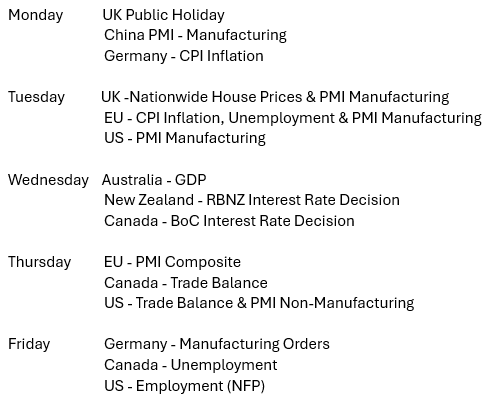
In the coming week, key economic data releases and events, in time order, include:
What’s in the news?
UK
A new mega poll by Survation suggests Reform UK would win more seats than Labour if there was a general election today. The survey of more than 10,000 people found that Nigel Farage’s party would be the largest party with 227 MPs.
Labour, which has enjoyed a poll bounce after Andy Burnham replaced Sir Keir Starmer in July, is second with 197 seats. The Lib Dems would win 72, while Kemi Badenoch’s Conservatives would be just behind with 71. The SNP would win 46 seats and Zack Polanski’s Green Party would have four MPs.
But Survation adds that Reform’s margins are thin, with just 100 of its seats considered safe and added that tactical voting, which could be a major threat to Reform, is likely to feature at the next general election.
A YouGov survey of 2,380 people conducted on the 23rd and 24th of August found that Reform UK has reclaimed its lead over Labour, suggesting the early boost enjoyed by Andy Burnham after entering Downing Street may already be losing momentum. Reform is on 23%, down one point, while Labour remains unchanged on 22%. The Conservatives have gained a point to reach 20%, leaving Kemi Badenoch’s party just three points behind Labour. The Greens and Liberal Democrats are both on 13%, while Rupert Lowe’s Restore Britain is on 3%.
Good news
A plant producing chlorine that cleans 98% of Britain’s drinking water has been saved from collapse by Jim Ratcliffe’s Ineos, in a move that also help could prevent the UK becoming reliant from imported salt for the first time in history. Ineos Inovyn, the chlorine arm of the billionaire’s chemicals empire has bought the remaining 50% stake of a Runcorn-based chlor-alkali plant that it did not own, giving it full control of the site that fell into administration last year. The deal is expected to complete before the end of 2026, is also likely to help stave off the failure of one of Britain’s last remaining salt plants, which neighbours the Runcorn chlor-alkali site and whose operations are interconnected.
The deal is still subject to regulatory approval, comes amid escalating concern that Britain’s industrial base is being hollowed out as a result of the country’s persistently high energy costs and carbon taxes. The chemicals industry has been a big casualty of the UKs sky-high energy costs, shrinking by 20% in the past three years.
The UKs National Wealth Fund is investing up to £71 million in reopening the Hemerdon tungsten and tin mine on the outskirts of Plymouth in a move ministers say will strengthen the country’s defence, energy and aerospace industries and reduce reliance on China for a strategically important mineral.
According to the Lloyds Business Barometer, business confidence has risen to its highest level since March and higher than the 12-month average, as resilient consumers shrug off the impact of the Iran war and Budget-related speculation is kept to a minimum. Optimism in the health of the wider economy rose to 49% and as many as 64% of bosses surveyed by the lender reported feeling optimistic about the state of the UK, and those that felt pessimistic slid to 15%.
Not so good news
British Gas boss Chris O’Shea says Britain has ‘almost no gas in storage’ because of its reliance on imports and risks winter fuel shortages. O’Shea, the chief executive of Centrica, says low gas storage levels should be a ‘national security’ issue. Britain’s gas facilities were around 30% full this week, down from 46% at the same time last year. They were more than 90% full in the two years before that. Gas levels are currently at the lowest level for August since records began according to Bloomberg.
O’Shea’s warning comes after Norway’s energy minister suggested Britain and Europe might no longer be able to rely on the Nordic country to keep a lid on energy prices by exporting surplus renewable energy most years via cross-border power cables from an extensive network of hydroelectric plants. It is also Europe’s largest supplier of natural gas, meeting around 30% of gas demand of both the UK and the EU.
O’Shea urged the Government to clear a pathway for a proposed £2bn redevelopment of its 40-year-old Rough Field offshore gas storage facility.
Graduates are facing the worst job market on record after graduate vacancies plunged by 45% under pressure from tax and the cost of doing business cost rises and technology as unprecedented numbers of teenager’s head to university. Employers are slashing entry-level hiring after Labour increased National Insurance contributions and the minimum wage, making inexperienced staff less attractive.
Research by BTG (Begbies Traynor Group) in its quarterly red flag report found that 53,756 UK businesses were in “critical financial distress” in the three months to June, up 9% from a year earlier. The deterioration was broad-based, with all but one of the 22 sectors monitored by the restructuring specialist recording an annual increase. The leisure and culture industry suffered the steepest deterioration, with the number of businesses in critical distress jumping 27.1%. Hotels and accommodation companies followed closely, with distress rising 26.6%. Sports and health clubs were also under mounting pressure, with the number in critical distress climbing 21% to 980, while food and drug retailers recorded an 18.4% increase.
Think tank Civitas report that Britain’s push for net zero has not resulted in lower energy costs. The report reveals that UK manufacturers paid an average of £238 per megawatt-hour (MWh) for electricity last year, about four times more than their international counterparts. Researchers estimated that British manufacturers spent £16.6bn on energy in 2024, which could have been £5.2bn less if they had US prices.
ONS (Office for National Statistics) data shows that UK Government borrowing unexpectedly rose to £1.8bn in July, £700m higher than a year earlier, despite economists having expected borrowing to be zero and the OBR (Office for Budget Responsibility) predicting a £500m surplus. This despite July seeing income tax receipts of £17.1bn, up £1.7bn year-on-year but this was outweighed by higher spending. Social benefit payments rose by £2bn, while debt interest costs increased by £700m to £7.7bn. Borrowing over the first four months of the financial year reached £56.7bn, exceeding OBR forecasts. Total UK debt stands at £2.985trn, or 94.1% of GDP.
The SMMT (Society of Motor Manufacturers and Traders) reported that UK car production fell by 10.6% in July. Exports dropped nearly 16%, affecting all major markets, including the EU and the US. Despite a 6.8% increase in fully electric and hybrid models, overall production remains below pre-pandemic levels.
Jim Johnson, the chief executive of Hunting, said the UK had become “uninvestable” and warned Andy Burnham’s hopes of rebuilding industry were doomed because of punitive oil and gas taxes and unpredictable policy decisions. Hunting, one of the London Stock Exchange’s oldest listed companies, shed dozens of staff and shut down 80% of its UK operations last year. Johnson said, “The reality is that Britain has become uninvestable. Everything your politicians have done has shown me that we cannot trust them. So why would I make a big investment here. It will never happen; the UK has become less investable than Venezuela.”
USA
The US Treasury and State Department announced a major secondary sanctions campaign labelled “Operation Economic Outcast,” designed to sever global financial lifelines to Tehran. Washington threatened secondary sanctions against any foreign financial institutions or entities facilitating trade with Iran, placing explicit pressure on global energy importers.
Transatlantic and continental trade disputes dominated headlines following the implementation of steep 50% tariffs on approximately $20 billion in Canadian imports, which prompted matched retaliatory duties from Ottawa on American metals and agricultural exports.
The US Treasury announced the creation of a specialized Quantum-Readiness Task Force aimed at assessing cybersecurity risks and updating encryption across critical federal financial networks to prepare for quantum computing developments.
The Federal Reserve’s preferred inflation metric, the Core PCE (Personal Consumption Expenditures) index held near 3.3% year-over-year, remaining elevated above the Fed’s 2.0% target. Headline inflation ticked up slightly due to rising energy costs.
Initial jobless claims fell to roughly 206,000, reversing recent summer upticks and signalling continued labour market resilience. Concurrently, the Conference Board’s LEI (Leading Economic Index) logged a modest 0.2% gain.
At the annual Jackson Hole Symposium on Friday, Federal Reserve Chairman Kevin Warsh gave a more hawkish reading of inflation than he did after the July Fed meeting. Warsh recommitted to the Fed’s 2% PCE inflation target and said elevated prices should be the central bank’s main focus and advocated for a ‘quieter’ central bank. Warsh also said short-term interest rates remain the Fed’s main tool, while AI and balance sheet questions are not driving near-term policy.
The Fed next meet on the 16th of September. The markets current expect a close-run decision between holding the benchmark Federal Funds Rate steady at 3.50%–3.75% and a 0.25% rate rise. A rate cut is virtually off the table with odds of below 2%.
President Trump announced a deal with Venezuela to get majority control of more than 65 billion barrels of oil reserves “at no cost to” U.S. taxpayers. Venezuela’s oil production has jumped under Washington’s custodianship. Meanwhile, Venezuela is also considering quitting OPEC, potentially dealing a further blow to the oil cartel it helped to found just four months after the UAE left.
Meta, owner of Facebook, Instagram and WhatsApp has agreed to pay up to $16.68bn to settle its blockbuster legal battle with more than two dozen US states over alleged failures of child protection and social media addiction, just as the case was getting under way in a California courtroom. Meta also vowed to institute sweeping changes to Facebook and Instagram, promising to hold users under 18 to two-hour daily limits and block usage at night without the user’s parental consent, potentially transforming how young Americans interact with social media apps and providing a template for thousands of similar lawsuits globally. Part of the settlement will only be paid out if TikTok and YouTube introduce similar restrictions.
Two people died from measles in Pennsylvania, the state’s first deaths from the disease in 35 years, with experts warning that figure could rise because of falling vaccination rates in the US. While numerous academic studies have shown no connection between the measles vaccine and autism, anti-jab sentiment has festered in much of the West, leading to some of their biggest outbreaks in decades. The US, which in 2000 won the status of having eradicated the disease, has registered almost 3,000 cases in 2026.
A Gallup poll states that marijuana use in the US is at a record high, while cigarette smoking sits at a record low with 17% of American adults saying they have smoked marijuana, tied with the high notched in 2023. That’s a big shift from 2013, the year Gallup started polling the question, when just 7% said they used pot. A record 15% of US adults also say they use edibles. The polling reflects the growing acceptance of marijuana use, especially for medical reasons. Meanwhile, cigarette use has dwindled to just 11% of American adults, steadily declining from a high of 45% in 1954.
The EU
The European Commission’s Economic Sentiment Indicator (ESI) rose to 98.4 points, outperforming consensus expectations and marking the strongest reading since early in the year. Optimism was propelled primarily by rebounds in the services sector and manufacturing expectations, particularly across major economies including France (+2.3) and Germany (+1.3).
Flash consumer confidence stabilized near -15.5 points. While corporate selling-price expectations continued to cool, consumer inflation expectations ticked higher, keeping financial markets attentive to potential ECB monetary policy adjustments heading into autumn.
The ECB (European Central Bank) next meet on the 10th of September. The markets currently see a 92% chance that the ECB will raise the deposit rate by 0.25% to 2.5%.
Analysts at Goldman Sachs are warning that European natural gas prices, vital to both industry and consumers, could this winter return to levels not seen since the Russia-Ukraine war triggered an energy crisis in 2022. Extreme weather and disruption to Middle East gas flows via the Strait of Hormuz have left Europe’s gas stores historically low for this time of year.
Germany’s GDP grew faster than previously thought in the second quarter, defying fears that higher energy costs driven by the Iran war would torpedo Europe’s biggest economy. German firms may have benefitted from the fact that Asian rivals were hit even harder by the choking off of trade via the Strait of Hormuz, reducing competition, but the figures nevertheless bolster a growing case among economists that markets have been unnecessarily downbeat on Europe’s prospects.
This week we have seen the fourth consecutive monthly increase in Germany’s flagship leading indicator, the IFO index, which rose from 86.6 in July to 88.8 in August. The index now sits at a one-year high, which is encouraging news, especially given lingering geopolitical pressures in the Middle East and tighter fiscal conditions. The more optimistic sentiment has also been consistent with the improvement in hard economic data seen in recent months, strengthening the case for a continued recovery.
Huge challenges remain, however, particularly for the German automakers with Volkswagen facing up to 100,000 job cuts as its CEO warns the crisis is ‘more than critical’.
Australia
The RBA (Reserve Bank of Australia) released its updated economic projections, forecasting GDP growth to slow from 1.9% down to 1.4% by the end of 2026 before a gradual multi-year recovery. Unemployment is projected to rise slightly to 4.5% by year-end.
Headline inflation is moderating toward 3.6% for late 2026, with the RBA anticipating a return to its 2%–3% target band by mid-2027. Headline inflation eased to 3.5% y/y from 3.8% but was above the 3.3% forecast.
Markets currently see an 86% chance of an RBA rate rise in November. The Australian Dollar has been among the top performing currencies of 2026 with the RBA raising rates on three occasions before voting to hold at 4.35% at their last meeting on 11 August. The RBA next meet on 29 September.
Meanwhile, major financial institutions are forecasting a softening in consumer spending and a projected slowdown in private business investment. Capital competition for AI, renewable energy transitions, and housing infrastructure remains tight amid elevated long-term neutral interest rates.
Canada
The headlines have been grabbed by the serious Canada-US trade escalation after the breakdown of high-level bilateral negotiations. Washington implemented a 50% tariff on roughly $20 billion of Canadian imports, focusing heavily on autos, auto parts, furniture, and electrical equipment. Ottawa retaliated by placing matched duties ranging from 15% to 50% on approximately $20 billion worth of American imports, targeting US metals, agricultural products, and manufactured goods.
Mark Carney’s federal government unveiled a $7.5 billion relief package featuring emergency loan programs for impacted businesses, expanded Employment Insurance (EI) flexibilities for displaced workers, and domestic supply-chain support.
Statistics Canada reported that the Canadian economy expanded at an annualized rate of 3.3% in the second quarter of this year, recovering from flat growth earlier in the year, propelled by solid domestic demand and robust export figures. Canada posted a C$8.8 billion current account surplus in the second quarter, sharp reversal from the C$8.3 billion deficit recorded in the first quarter and its strongest current account balance since 2005.
Canada’s Big Six banks reported their third quarter financial results. Earnings surpassed analyst expectations at RBC (reporting C$6 billion in quarterly profit), CIBC, BMO, Scotiabank, and National Bank, bolstered by capital markets, wealth management, and commercial banking operations.
In the last 24 hours, Canada hinted that a path to deescalation might be at hand. Then Trump turned the dial, signing an executive order to rename Lake Ontario, which sits between the US and Canada, “Lake America.” Trump said, “We have a gulf and we have a lake. Now, all we need is an ocean.” Canadian Prime Minister Mark Carney responded, saying the lake was named before either country existed, and that Canadians would continue to call it “Ontario”. Trump’s move suggests a truce isn’t near.
Others
The UAE is one of the countries most exposed as President Trump targets Iran’s trade lifelines. The Trump administration threatened to cut off any entity that launders money for Iran from the US dollar system. This could significantly sever the economic lifeline that has sustained Tehran’s economy through nearly six months of war. China, the UAE, Turkey, Iraq, and India are among the top trading partners of Iran.
The US announced an “economic D-Day” campaign on Monday to isolate Iran from the global economy, threatening penalties against “enablers” that continue doing business with Tehran.
The UAE, located just 50 miles from Iran across the Persian Gulf, has long been a major trading hub for Iran. Bilateral trade amounted to around $28 billion in 2024, when the Emirates was its largest source of imports, contributing over 30%. The UAE was also Iran’s third-largest export destination, making up 12% of its shipments, totalling more than $7 billion. That relationship hit a snag last week as the UAE moved to suspend all trade and financial transactions with Iran, following two ballistic missiles fired toward Emirati territory, one of which targeted UAE-owned tankers. Iran has relied on UAE banks and its financial system to access the world economy through illicit, often murky transactions, and cutting off Iran would require more forceful actions from Emirati authorities to crack down on opaque financial and trading activity according to US-based think tank The Washington Institute.
Dubai’s air traffic has fallen by more than 30% since the start of the Iran war. In 2025, Dubai received more than 60 million passengers, making it the world’s second busiest airport by passenger traffic, only behind Atlanta in the USA. Dubai’s airport had forecast close to 100 million passengers for 2026 before the conflict began, but since then tourists have opted for European destinations, while airports like Istanbul’s are benefitting from becoming the connection between East and West.
Gold has surged by nearly 16% in Dollar terms since mid-July with the price, in Pounds Sterling has posted its sharpest monthly rise in more than a decade in August as concerns over government debt, fiscal deficits and the risk of currency debasement return to the fore. The latest surge highlights the extent to which gold has moved beyond its traditional role as a defensive asset during market shocks and become a broader hedge against doubts over the sustainability of western public finances.
Wheat futures have hit their highest level in more than three years as the war in Ukraine strains supplies, further weakening the global food system. Kyiv and Moscow have stepped up attacks on the Black Sea, a key transit route for a large share of global grain exports, as they try to weaken each other’s economies. Together, the two countries account for around a third of global wheat exports.
Stranger than fiction
NASA’s Nancy Grace Roman Space Telescope is scheduled to launch this weekend, with scientists hoping for clearer views of the early universe, insights into dark matter, and greater-than-ever power to hunt for distant planets. Roman’s broader field of view means it can study millions of stars every few minutes for telltale dips in brightness that indicate a planet is passing; researchers think it could reveal 100,000 new worlds during its lifetime. For comparison, just 6,000 have so far been discovered, all since 1992. The new telescope will also be able to locate smaller planets more accurately.
Coral is growing back on the Great Barrier Reef. Cover in the northern section rose from 30% to 35.1% between 2025 and 2026 and in the central section from 28.6% to 31.6%, both now above the long-term average.
Quote
Dolly Parton, “Don’t get so busy making a living that you forget to make a life.”