
09/05/2026 by Tony Redondo
The bond market remains the central nervous system of global finance, significantly larger and often more influential than the stock market, with an estimated value of approximately $150 trillion. The global corporate bond segment alone is projected to reach around $45 trillion in 2026, with the remainder largely comprised of sovereign debt, which has surged over the past decade as nations financed pandemic recovery and navigated subsequent geopolitical shifts.
Gilt Yields at Multi-Decade Highs
UK 30-year gilt yields touched 5.76% this week, the highest since 1998 while the benchmark 10-year gilts are yielding 5.08%, compared to 4.43% on the equivalent US Treasury, meaning Britain is currently paying 65 basis points more than America to borrow money. French OATs yield 3.40–3.60% and German Bunds 2.60–2.80%. The spread between UK gilts and German Bunds has now widened to over 200 basis points, a clear signal that investors are demanding a significantly higher risk premium to hold British debt than comparable European paper.
The last time 30-year gilts sat at these levels, Tony Blair was in Downing Street. There has been no bank failure, no Lehman moment, no Global Financial Crisis. As we saw in 2022 following the Truss mini-Budget, the bond markets are apolitical. They simply price the truth.
A Stagflation Trap in the Making
What the bond market is pricing is a stagflation trap with the potential to evolve into outright demand destruction. Yields are rising because energy costs, fiscal risk, and inflation uncertainty are pushing the term premium higher, but the underlying message is not one of strength. The UK consumer, the business sector, and the government’s own balance sheet are being squeezed simultaneously.
A rising 2-year yield reflects tighter central bank policy. A surging 30-year yield, now near 5.8%, its highest since 1998 suggests investors are questioning the long-term cost of financing the state itself. This is not a normal growth signal. It is the market demanding greater compensation to hold long-term UK debt.
The Twin Crisis: Bonds and Sterling
We may be in a slow-motion sovereign debt crisis and what follows such a crisis, as surely as night follows day, is a run on the currency. In my working lifetime, post-1985, there has never been a UK bond crisis without a subsequent collapse in the value of the Pound. They are almost always twin crises. Given the UK’s twin deficits, fiscal and current account, the bond market and the currency are inextricably linked. When investors lose faith in the government’s ability to manage its debt, selling bonds and pushing yields higher, they simultaneously sell the pound, the currency in which that debt is denominated.
Historical precedent illustrates the pattern clearly:
- Black Wednesday (1992): A massive sell-off in both bonds and sterling forced the UK out of the European Exchange Rate Mechanism. The pound lost roughly 15% of its value within weeks.
- The Global Financial Crisis (2008): Though not initially a gilt-led crisis, the collapse in confidence produced a simultaneous spike in borrowing costs and a record fall in sterling against both the dollar and the euro.
- The Mini-Budget Crisis (2022): The textbook example. The announcement of unfunded tax cuts caused gilt prices to collapse, yields to spike, and the pound to fall to an all-time low of $1.03 against the dollar and €1.10 against the euro. Notably, UK 10-year gilt yields have since surpassed even the highs seen during the Truss episode, following Rachel Reeves’s October 2025 Budget.
The pattern is consistent: whenever the 10-year gilt yield approaches 5%, sterling comes under heavy pressure, frequently weakening against the euro as investors rotate into the relative safety of German Bunds. In an open economy, when the bond vigilantes arrive, the currency speculators are rarely far behind. The eurozone crisis offers a cautionary parallel. When Greek, Irish, and Portuguese sovereign yields approached 7%, those countries were forced to seek IMF bailouts as market borrowing became unviable.
Political Risk Compounds the Problem
The immediate backdrop is a damaging set of local, Scottish, and Welsh Parliament election results, with Labour suffering what can only be described as a record drubbing, including losing political control of Wales for the first time since devolution in 1999. Even if Sir Keir Starmer and Rachel Reeves survive in office, they will face intense pressure to shift leftward, undermining already half-hearted plans for fiscal consolidation.
Should they be forced out, their likely successors appear even less inclined to heed the bond market’s warnings. Andy Burnham, Mayor of Manchester, has been explicit on the point, arguing that policy is too beholden to bond markets and advocating for borrowing outside the fiscal rules to fund increased defence spending. This is precisely the kind of rhetoric that makes markets more nervous, not less.
Neil Mehta at RBC BlueBay commented, “I think if it’s Rayner or Burnham, the general reaction from bond markets is not going to be positive.” Investors, he notes, want to see an improving economy and higher taxes are rarely conducive to that.
The IMF’s Verdict
Recent IMF analysis confirms the scale of the challenge. Even under current plans, let alone anything more expansionary, Britain’s tax burden is on course to reach its highest level since the Second World War. Taxes are set to rise by more during the remainder of this Parliament than in any other country in the world. For a government already struggling to retain the confidence of the gilt market, that is an extraordinarily uncomfortable place to be.
Currency Exchange Rates Update
April was a good month for the Pound. Seasonality has a very powerful hold on the Pound at this time of the year as a significant number of UK-listed companies that earn overseas repatriate revenues to pay Pound Sterling denominated dividends at this time of the year. That creates real non-speculative demand for the Pound. Other drivers played their part too with risk sentiment improving as the markets saw the worst of the Middle East conflict pass by.
Lloyds Bank says the Pound Sterling’s resilience against the euro is unlikely to last, warning that the UK economy faces an increasingly difficult mix of slowing growth and persistent inflation. Nick Kennedy, strategist at Lloyds Bank says, “A weak labour market and decelerating wage growth might reduce second round risks, but that also means these conditions ought to push the economy towards stagflation.” The euro can outperform the pound thanks to the eurozone economy’s ongoing resilience in the face of the energy shock caused by the Iran war. Kennedy says, “The region has a solid labour market and a constructive fiscal and investment story,” the report, which adds that the ECB commands more credibility in confronting inflation risks. Inflation is starting from a low level, and monetary policy is at neutral; a couple of hikes would be manageable.”
The contrast leaves Lloyds arguing that the Pounds current support from its interest rate differential against its major currency peers may prove increasingly difficult to sustain.
Global demand for USD remains incredibly high with offshore US Dollar deposits held in banks outside the US are up to a record $14.5 trillion. This is +220% more than the $4.5 trillion held at the beginning of the century. By comparison, only $3.5 trillion worth of euros are held in offshore banks, outside the Eurozone. The Fed and domestic commercial banks hold over $19 trillion. This means offshore US Dollar deposits are now equivalent to 43% of US domestic bank deposits, with no other currency coming close to this percentage.
In the coming week, the key economic data releases and significant events include:
Monday China CPI Inflation
Tuesday Germany CPI Inflation & ZEW Business Confidence
US CPI Inflation
Wednesday EU GDP
US PPI Inflation
Thursday UK GDP & Industrial Production
US Retail Sales
Friday US Industrial Production
What’s in the news?
Shipping giant Maersk has warned of the most comprehensive energy shock in our lifetime as costs surge. Maersk says it is absorbing a monthly hit of around $500 million from disruption linked to the Iran conflict, as rising freight rates and energy volatility ripple through global supply chains. The Danish shipping giant, carries roughly around one in five of the world’s seaborne containers, said the disruption is driving a sharp increase in costs in the current quarter and beyond, although it has so far offset the impact by raising prices for customers.
Andrew Bailey, Governor of the Bank of England says Britain ‘needs allies’ to boost economic growth in his latest pro-Europe remarks. Bailey has urged Labour to pursue closer ties with the EU on multiple occasions in recent years and backed Sir Keir Starmer’s plans to reset Britain’s relationship with the bloc. Speaking at a Bank of England conference, Mr Bailey said, “We’re an open economy, we do need allies. I think seeking to rebuild trade relations with Europe is a sensible thing to do. I always sort of try to skip around the Brexit debate per se because I’m a public official, but I usually lean on Adam Smith at this point and say: ‘Look, we learned from Adam Smith the relationship between trade and growth.’”
His comments will be welcomed by Sir Keir who is set to outline plans to bring Britain closer to Brussels as soon as Monday in an effort to recapture momentum after a historic defeat for Labour in the local elections. Sir Keir signed a “reset” deal with the EU last year, which will force the UK to follow European food standards and submit to the European Court of Justice. The agreement will result in fewer customs checks on exports to EU nations but means that Britain will agree to follow the bloc’s rules without having a say over their design. Britain will also be forced to pay into the bloc’s budget, making financial contributions for the first time since it left the EU.
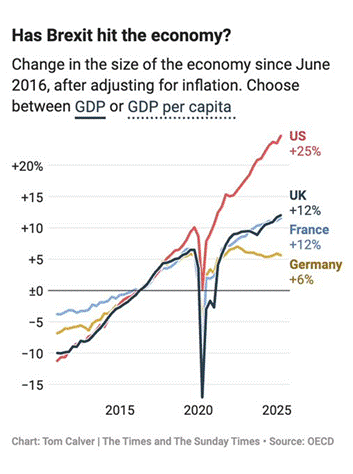
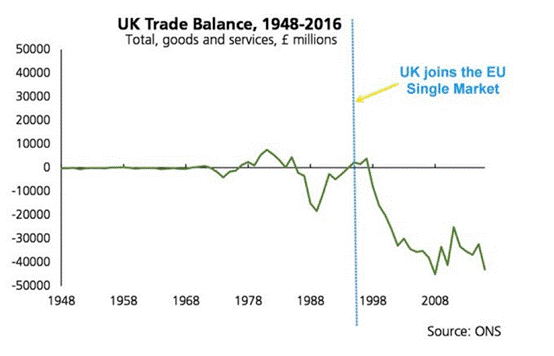
Some may argue that official data paints a different picture about the supposed impact of Brexit and the wisdom of Starmer’s reset.
UK
Sir Keir Starmer has named Gordon Brown a trade adviser to Downing Street as he seeks to reset his premiership after Labour’s local election defeat. Mr Brown, the Labour prime minister from 2007 to 2010, will become the Government’s special envoy on global finance in an effort to boost “the country’s security and resilience”. It’s 27 years since the infamous “Brown Bottom,” when Gordon Brown made the decision to liquidate Britain’s gold on 7 May 1999. The UK went on to dump 400 tonnes of gold, representing more than half of its reserves, for an average price of $275. Global gold prices closed on Friday at $4,723 having reached $5,589 in January.
Good news
Data from the SMMT (Society of Motor Manufacturers and Traders) shows the UK’s car market staged a sharp recovery in April, with registrations surging by 24% in April as buyers returned after a tax-driven slump the previous month. Growth in April was broad-based, though led by fleets, where registrations climbed 26.8% as businesses renewed vehicles and capitalised on improving supply. Private buyers also returned to showrooms, with retail registrations up 20.2%, while smaller businesses posted a more modest 15% increase.
Bank of England data shows that mortgage approvals for home buyers hit a four-month high in March. This is the highest total since November and exceeds the six-month average. Karim Haji, global and UK head of financial services at KPMG, said, “The uptick in approvals for house purchases and remortgaging is surprising given the surge in rates during March. This may point to some resilience in the market, but overall affordability remains under pressure.”
Not so good news
An analysis of ONS data shows that UK job vacancies are down 16% year-on-year and at their lowest level since 2021. Wage growth just hit its slowest pace in over 5 years. Unemployment is forecast to rise to 5.5% by end of 2026.
https://www.express.co.uk/finance/personalfinance/2196963/reeves-national-insurance-decision-leaves
Data from the Insolvency Service shows the UK could be entering one of its most severe periods of job losses in more than a decade, as rising costs, weak demand and global instability combine to place mounting pressure on employers. Redundancies across the UK have risen by 45% since 2021, underlining a sustained increase in workforce reductions. Richard Hunt, director at Liquidation Centre, warned that up to 327,000 workers could lose their jobs in 2026, a level of job losses that would approach those seen during the 2009 financial crisis. The warning comes after 736 employers filed redundancy notices in the first two months of this year alone, affecting more than 56,000 roles. This represents an 8.5% rise on the same period last year, while 2025’s total of 315,605 potential redundancies was already the highest since the pandemic.
New research based on ONS (Office for National Statistics) data shows employee sickness absence costs UK businesses an estimated £11.8bn in lost profits in 2025, underscoring the growing economic impact of workplace illness on firms already facing tight margins. The findings highlight the significant financial strain on employers from illness-related absences, particularly as firms continue to grapple with broader cost pressures and productivity challenges. Small and medium-sized enterprises appear to be disproportionately affected, with employees in organisations employing fewer than 50 staff accounting for around 47 million sick days.
The BBPA (British Beer and Pub Association) says the UK is losing pubs at nearly two a day as a mix of rising taxes, labour costs and falling consumer confidence takes its toll. In the first three months of the year alone, 161 pubs shut their doors for good, a 26% increase on the same period last year. The closures have already cost an estimated 2,400 jobs, with younger workers disproportionately affected.
The S&P Global UK construction PMI (Purchasing Managers’ Index) dropped from 45.6 in March to 39.7 in April, signalling a marked contraction in output and the fastest deterioration since late 2025. Any reading below 50 indicates shrinking activity. The decline reflects broad-based weakness across the sector, with civil engineering particularly affected, while both residential housebuilding and commercial construction continued to contract. Analysts said rising energy and fuel costs, linked in part to the fallout from conflict involving Iran were feeding through the supply chain, driving a rapid increase in purchasing prices for builders. Kelly Boorman, head of construction at audit firm RSM UK, said, “Local elections this week could cause further uncertainty among contractors around where future infrastructure spending will be focused. There is a significant risk that some planned projects will become unviable in the current economic climate, particularly for long-term fixed price projects, so we may see some large infrastructure projects put on hold.”
USA
A BLS (Bureau of Labor Statistics) report shows US employers went on a hiring spree in March with the US economy adding 115,000 jobs in April, exceeding Wall Street’s expectations for the second month in a row, while the unemployment rate held steady at 4.3% and the official US hiring rate hitting 3.5%, the highest it’s been since 2024. Hiring was especially strong in transportation, warehousing, and utilities, and was solid in professional and business services. Scott Clemons, chief investment strategist at Brown Brothers Harriman, said, “the report is evidence of the underlying resilience of this economy and of this labor market, despite all of the slings and arrows of outrageous concerns about the Middle East and unemployment and inflation and the Fed”.
Surging gas prices due to the Iran war sent consumer sentiment to a new record low in the early part of May according to a University of Michigan survey published on Friday. The survey’s director, Joanne Hsu, said, “Taken together, consumers continue to feel buffeted by cost pressures, led by soaring prices at the pump.”
The US equity markets had a remarkable April, delivering a powerful risk rally, with the S&P 500 up about 10.4%, the Nasdaq up about 15.3%, and the Dow up about 7.1%. Investors largely treated the energy shock as noisy and temporary, and they were willing to pay up for growth and earnings visibility even while the oil tape stayed volatile and the rally has extended into May. The S&P 500 closed yesterday at another record, notching its longest weekly winning streak since 2024. All three major averages posted weekly gains, propelled by strong earnings. Upbeat tech earnings lifted the Nasdaq to a 4.5% climb, while the S&P 500 gained 2.3%. The Dow Industrials lagged with a week-to-date gain of 0.2%.
The US has secured control of one of the largest heavy rare earth deposits outside China, in Greenland. American mining company Critical Metals Corp has received formal approval from the Greenland government to acquire 70% of the Tanbreez deposit in southern Greenland with an estimated resource of 4.7 billion tonnes of rare earth bearing material. 27% of those rare earths are heavy rare earth elements, (the ones used in EV motors, wind turbines, and advanced military systems). Production is expected to begin 2027–2028, starting at 85,000 tonnes of rare earth oxides per year, scalable to 425,000 tonnes. Project value estimated at $3 billion. China controls 85% of global rare earth processing capacity. The US currently imports 80% of its rare earths from China.
A proposed $2 billion Alberta-to-Wyoming pipeline that would ship upward of half a million barrels of oil a day from Canada into the US is moving closer to reality after the Bridger pipeline expansion project got a border-crossing permit from President Trump last week and initial comments for its environmental review closed on Friday, with final permits expected next year before construction starts.
According to new Gallup polling, more Americans are getting nervous about saving enough for retirement. Nearly seven in 10 non-retired Americans are somewhat or very worried about not having enough money when they stop working, close to the high of 73% recorded in 2010, shortly after the financial crisis. At the same time, just four in 10 current retirees share the same worry, close to the average over time. Overall, only 45% of non-retirees think they’ll have enough to live comfortably in retirement, a figure that ticks higher among younger adults, compared with 82% of retirees who say they have enough.
A new AP-NORC survey of Americans ages 13 and up shows that the youngest media consumers are omnivores; 13-to-17-year-olds said social media (57%) was their top source of daily news, and TV, their parents’ favourite source, was their No. 2. But sizable portions also said they get news each day from search engines (37%), email (24%), radio (24%), and chatbots (22%), a more even spread than older cohorts. And 57% of teens said they “sometimes” or “often” get information on national news from influencers or independent creators (compared to 44% average across age groups). Another finding from the survey suggests the reason why. Teens distrust all news sources roughly equally, except for AI, which they trust even less.
The EU
One year into office and German Chancellor Friedrich Merz has been accused of falling behind on his core goals. Merz took office with the aim of restoring Berlin’s leadership in Europe and bridging a frayed transatlantic relationship. But his recent comments on the US-Iran war strategy have antagonized President Trump while the AfD opposition party continues to surge in the polls. His coalition government is beset by infighting, and the economy is still weak. Mr Merz’s approval ratings are now even worse than his predecessor’s Olaf Scholz’s were, with one poll rating him as the least popular leader in the free world.
Germany is not the economic powerhouse it once was after losing access to cheap Russian gas during the Ukraine war and increasing US tariffs hitting its exports. Its once-mighty car industry, ravaged by cheap Chinese electric car imports, is facing unprecedented factory closures. Mercedes-Benz reported a 49 per cent drop in profit in 2025 and the wider manufacturing industry is estimated to be losing as many as 15,000 jobs per month. The economy contracted in both 2024 and 2025, and unemployment last October reached 6.3%, the highest rate in a decade. German industry leaders, who had hoped that Merz could make real progress on boosting the stagnant economy are also losing patience.
Peter Leibinger, head of the Federation of German Industries, says, “After a year, business is deeply unsettled. There is no comprehensive plan for concrete reforms that would boost growth and competitiveness. The delay threatens to pose an existential threat to the country’s position as an industrial hub.” Merz’s coalition will increase public spending to €543.3bn in total next year, a 3.5% increase from last year, in a country where fear of inflation runs deep.
Spain’s foreign-born population has jumped from one in 20 residents to one in five since the millennium, and it is adding around 665,000 new immigrants a year. While most other Western countries are tightening border controls, Madrid has maintained an open-door policy according to the Financial Times. Spain accounts for a third of total net EU migration, with Latin Americans by far the largest group. The government last month approved a mass amnesty program, giving 500,000 undocumented migrants the right to residency, prompting concerns in Brussels and among several EU members. Spanish GDP is growing faster than any other large, advanced economy, but the country also has a painful housing crisis, and the ruling Socialist party faces a populist backlash.
Others
China’s April exports rebound strongly after a sluggish March, and its trade surplus has widened. Exports grew by 14.1% in April year-on-year in US dollar value terms, accelerating from March and beating forecasts. China’s trade surplus grew from $51.13 billion in March to $84.8 billion in April. Factory data published last month showed input prices remained elevated. Unemployment rates edged higher and retail sales underperformed. New export orders rose to their highest level in two years. Imports notched another strong month in April, climbing 25.3% after a 27.8% rise in March. US President Donald Trump is expected to visit China this coming week for a meeting with Chinese President Xi Jinping, a trip that could yield gains on farm trade and airplane parts but is unlikely to soften deep strategic rifts, especially over Taiwan.
The RBA (Reserve Bank of Australia) raised its cash rate by 25 basis points to 4.35%, matching its December 2024 peak and its third rise this year in an 8–1 board vote, underscoring the RBA’s determination to rein in stubborn inflation pressures, even as growth risks linger. The RBA also appeared to signal that more rate rises were on the horizon, with its economic forecasts pencilling in a 4.7% policy rate in December 2026. Should the policy rate exceed 4.35%, it would be the highest since December 2011.
New Zealand’s unemployment rate fell to 5.3% in the first quarter, beating forecasts for a steady 5.4%. The decline was driven by fewer people actively seeking work, which pushed the participation rate down to 70.4%, slightly below expectations of 70.5%.
Man Group, the world’s largest listed hedge fund manager, is opening an office in Abu Dhabi, as is Capital Group, the latest two firms to commit to the UAE’s financial centres despite the uncertainty caused by the Iran conflict. Man Group said it would use its new presence in Abu Dhabi’s finance hub ADGM for distribution, investment, and trading, adding to the international firms that use the UAE capital as a key part of their operations. Active investment manager Capital Group said it would open its first Gulf office in ADGM later this year.
Venezuela’s oil exports have reached their highest level since 2018. Crude production in Venezuela, which holds the world’s largest oil reserves has surged since the US captured former President Nicolás Maduro and replaced him with a leader who agreed to Washington’s demands to open the oil industry to private investment. The easing of restrictions has swayed some of the world’s biggest firms, including Exxon, whose CEO had previously said Venezuela was “uninvestable.”
Stranger than fiction
A new hybrid wheat variety is up to 70% more resistant to a devastating and widespread fungal disease. Fusarium head blight reduces wheat yield and causes illness in humans, so infected crops must be destroyed. Adding a gene from a resistant weed reduces infection severity. Since the 1960s, the rise of selective breeding and genetic engineering has created plant strains that are more resilient to diseases and droughts, as well as providing more nutrient-rich varieties such as high-iron beans or vitamin-boosted rice.
Quote
Ayn Rand, “When a businessman makes a mistake, he suffers the consequences. When a bureaucrat makes a mistake, you suffer the consequences.”