
25/07/2026 by Tony Redondo
Politicians are often accused of not letting facts get in the way of their argument, but it disappoints me that someone who has worked in the financial markets and therefore really ought to know better can be so very wrong. I’m talking about the row over wealth inequality, and whether new PM Andy Burnham should introduce wealth taxes in this autumn’s budget.
Some, like ex-trader turned campaigner Gary Stevenson, and ex-footballer, pundit and crisps aficionado Gary Lineker, think Britain’s wealth inequality is spiralling out of control. As economist Kristian Niemietz points out, a recent Channel 4 documentary never bothered to check the facts.
Data from the ONS (Office for National Statistics) and global wealth databases, including Credit Suisse and UBS Wealth Reports, shows Britain is actually remarkably egalitarian. The top 1% hold roughly 20–22% of aggregate personal wealth, a share that has stayed almost flat for over twenty years and is close to its lowest point on record. For most of the twentieth century it was far higher. It’s also one of the lowest levels in the developed world and 3% below the European average, and five below Sweden or Germany.
There is complete confusion in the minds of inequality campaigners between income and wealth. Britain ranks relatively high among Western nations for income inequality but sits near the mid-to-lower end of developed nations for wealth inequality, whether measured by the Gini coefficient or the top 1% share.
None of this has stopped the enthusiasm for wealth taxes, but the historical record ought to give any Chancellor pause. Of fourteen European countries that ran a broad wealth tax over the past sixty years, all but three repealed it, citing capital flight, disappointing revenue and high administrative costs. The typical take was just 0.5–1% of GDP, low relative to the economic disruption it caused.
France’s ISF is the textbook case. One estimate puts the country’s total capital flight at €200 billion between 1988 and 2007, potentially dragging GDP growth down by an average of 0.2% a year, before Macron scrapped it in 2018. Germany’s experience was scarcely more flattering. It was axed in 1996 having raised just 0.8% of total revenue. Even Sweden, hardly a low-tax outlier, abolished its wealth tax in 2007 amid concerns over capital flight.
Today only Norway, Spain and Switzerland still impose broad taxes on net assets. Norway’s recent experience is instructive: an increase in its wealth tax in 2022 prompted more ultra-wealthy households to leave the country that year than in the previous thirteen combined.
But none of this is quite the fair comparison it first appears. Switzerland’s wealth tax largely substitutes for the capital gains tax it doesn’t otherwise levy, and Norway scrapped inheritance tax altogether in 2014. So, of the three countries still running one, only Spain actually stacks a wealth tax on top of a full suite of income, capital gains and inheritance taxes, precisely the model on the table for the UK. And Spain is the one generating the exodus stories. Its 2023 solidarity wealth tax has spooked enough wealthy residents that Portugal extended its own non-resident tax perks to catch them.
Currency Exchange Rates Update
The Pound Sterling continues to slip from its mid-month highs with its poorest week against the Euro since May and weakest week in five against the US Dollar on softer risk sentiment and rising oil prices favouring commodity-linked currencies like the Australian and Canadian Dollars.
In the coming week, the key economic data releases and significant events include:
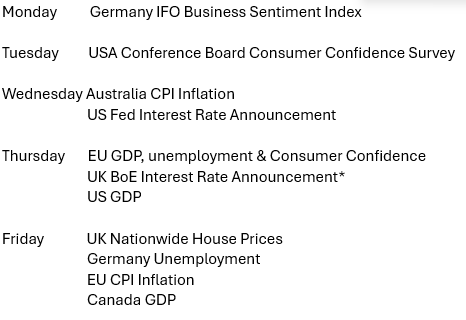
*Most analysts expect the MPC to keep the UK base rate unchanged at 3.75% with a 7-2 vote the most likely outcome with the majority likely to frame the decision as an active hold, despite Chief Economist Huw Pill’s warning that the “fog of uncertainty” should not become an excuse for inaction.
The BoE will also provide its latest Monetary Policy Report with updated projections to provide the key signal on whether market-implied rate rises are needed to return inflation sustainably to target
What’s in the news?
UK
Good news
The CPI Inflation data for June showed inflation easing to a 15-month low, but this is likely to be as good as it gets. UK CPI inflation slowed to 2.6% in June from 2.8% in May. Transport and food provide the largest downward contributions to headline inflation. Services inflation eases to 3.6%, while goods inflation slows further to 1.7%.
Not so good news
The bond markets welcomed Andy Burnham’s ascension to 10 Downing Street with a flash warning as UK borrowing costs hit the highest in the G7. The yield on the benchmark 10-year gilt rose to 5.0862% on Thursday, its highest level since May, while 30-year borrowing costs climbed to 5.7775%, reflecting growing unease among investors over the UK’s long-term fiscal outlook.
The moves leave Britain paying the highest long-term borrowing costs of any G7 economy. Comparable 10-year government bond yields stand at around 4.6% in the US, 3.3% in Italy, 3.2% in Canada, 3% in France, 2.8% in Germany and 2.5% in Japan.
Investors were demanding a larger premium to lend to Britain because of persistent concerns over inflation, elevated government borrowing and the country’s medium-term fiscal trajectory. Unlike the sharp spike triggered by Liz Truss’s 2022 minibudget, today’s market pressures have emerged gradually. Rather than responding to a single policy announcement, investors are reassessing Britain’s structural economic position against a backdrop of higher global interest rates and mounting public debt. That debt has now approached £3 trillion, equivalent to around 95% of GDP, its highest level in more than six decades. Higher gilt yields feed directly into the cost of servicing government debt, with annual interest payments already estimated at around £110 billion, more than the budgets for the Education, Transport, Defence, and Home Office budgets.
The challenge for new Chancellor John Healy extends beyond managing day-to-day spending. Rebuilding investor confidence will require credible plans to improve productivity, stabilise public finances and generate stronger long-term growth. Until then, financial markets appear determined to keep charging Britain a premium for the privilege of borrowing. And let’s hope John is more successful than his namesake Denis Healey, Labour’s Chancellor in the mid-1970’s when the OPEC oil price crisis led to the UK going cap in hand to the IMF for a bailout in 1976, exactly 50 years ago.
In a research note to clients, investment bank Panmure Liberum concluded that ex-PM Sir Keir Starmer and ex-Chancellor Rachel Reeves left the UK ‘no better off than they found it’ as their missteps in energy and housing policy meant it was “difficult to conclude” that the country’s economy had improved in the two years since the general election. Chief economist Simon French wrote that the “new UK disease of prioritising luxury beliefs over hard-nosed competitiveness” cast a shadow over the pair’s economic legacy.
ONS data shows youth unemployment has hit a fresh 12-year high in the three months to May. The ONS found 16.4% of the nation’s 16- to 24-year-olds are now unemployed. This is worse than anything seen in the pandemic and represents the highest rate since late 2014.
The ONS also reported that in the second quarter, job vacancies in the UK have decreased by 7,000 to 712,000 in the three months to June, as small businesses reduce hiring due to rising costs and wage pressures and private sector wage growth fell below 3% for the first time since 2020. Despite this decline, the overall unemployment rate remained steady at 4.9%.
USA
The White House initiated a massive wave of trade measures on Friday using Depression-era and national security trade statutes including section 301 Tariffs with Washington enacting new 10% to 12.5% tariffs on exports from 60 major trading partners including Britain and the European Union citing supply-chain compliance issues.
Ahead of this autumn’s mid-term elections and with artificial intelligence infrastructure straining the national power grid, the Trump administration and several Republican governors launched a high-profile initiative to shield residential ratepayers from skyrocketing electricity bills.
Core PCE inflation forecasts for year-end were revised upward to 3.4% (from 2.9%), driven by global supply disruptions in energy and key commodities.
Americans’ confidence in US institutions continues to slide, and few have fared worse than the press. Gallup updated its annual survey last week of Americans’ feelings about more than a dozen governmental bodies and industries. The poll found that in 2026, confidence in newspapers fell to a near-record low of 17%, while confidence in TV news picked up from 11% to 14%. That’s still the second-from-worst on the list, just ahead of Congress, with 9% confidence. Gallup has only polled respondents about technology companies for a few years, but the trend so far suggests Americans are growing more sceptical of Silicon Valley, too with 20% saying they’re confident in Big Tech in 2026, down from a 2020 high of 32%.
The EU
Transatlantic trade tensions reached a new high after the US administration enacted new 10% to 12.5% tariffs targeting imports from 60 major trading partners, including the European Union. Washington invoked Section 301 of the 1930 Trade Act, claiming partner nations failed to enforce adequate supply-chain bans on forced labour. European Commission officials firmly rejected the allegations, calling the duties unjustified and signalled that the bloc is reviewing legal remedies and potential countermeasures through the WTO (World Trade Organisation) and bilateral channels.
In a major enforcement action under the Digital Markets Act, the European Commission issued an €890 million fine against Google. Regulators cited two primary breaches. Self-preferencing Google’s own specialized search services over independent rivals, and anti-steering practices within the Google Play app store that limited developers from pointing users to cheaper external payment channels.
On Thursday, the ECB (European Central Bank) held its benchmark interest rate unchanged at 2.25% amid energy price volatility. ECB President Christine Lagarde noted that while core inflation in the Eurozone continues to moderate toward the 2% target, ongoing Middle East geopolitical tensions and volatile crude oil prices warrant a cautious, data-dependent approach before considering further rate cuts.
Lagarde’s term of office ends in October 2027 amid mounting speculation she will step down six months early in April next year to allow President Macron and Chancellor Merz to settle on her successor in good time before France’s presidential elections. The current favourite is BIS supremo Spaniard Pablo Hernandez de Cos.
More than 288,000 German citizens moved abroad within a single year. Germany recorded roughly 97,000 more German citizens leaving than returning, the largest net loss since 2017. This is no longer limited to retirees looking for sunshine. The skilled and productive are searching for an escape from a system that increasingly punishes them for working.
An Indeed survey found that 54% of respondents with household net income of at least €6,000 had applied for jobs abroad or investigated the international labour market during the preceding 12 months. Two-thirds said they generally considered taking employment abroad, while 77% of those interested in leaving expected to remain outside Germany for several years or permanently. Around 51% cited higher income, another 51% wanted a better quality of life, and 42% were seeking a lower burden of taxes and social contributions. Seventy percent said Germany’s tax burden was too high relative to income and that personal commitment at work did not pay sufficiently.
Germany has created one of the heaviest tax wedges in the industrialized world. Euronews noted that an average single employee retains only €50.70 from every €100 spent by the employer on labor. The remainder disappears through income taxes and the social contributions paid by both employer and employee. The OECD placed Germany’s tax wedge for an average single worker at roughly 49.2% in 2025, compared with an OECD average of 35.1%.
Australia
Australia’s economic and political news over the past week has been dominated by fresh trade friction with Washington, looming inflation threats, housing market headwinds and the rise of Pauline Hanson.
The Trump administration has imposed a 12.5% duty on select Australian exports, citing non-compliance regarding modern slavery and forced labour rules in global supply chains. Australia was grouped alongside countries like Japan, Brazil, and New Zealand on a secondary list. Trade Minister Don Farrell and the Albanese government firmly rejected the claims, calling the tariffs “completely unjustified” and incompatible with the Australia–US Free Trade Agreement. The silver lining? Australia’s largest export categories, including beef and gold were excluded from the tariff list, muting the immediate macro impact.
The renewal of the war with Iran has driven Brent crude oil prices back above $100 a barrel, putting renewed pressure on Australian households and the RBA (Reserve Bank of Australia). Markets and economists now see an increased probability of an RBA cash rate rise announcement at their next meeting on 11 August to head off sticky inflation expectations, even as broader consumer demand weakens.
New economic projections from major lenders, including CommBank show that a cooling housing market, rather than energy prices is becoming the primary drag on Australia’s domestic economy.
Annual GDP growth is projected to moderate toward 1.5% by late 2026, with unemployment forecasted to tick up toward 4.8%.
Domestically, the Australian political landscape is seeing a major shakeup as Pauline Hanson’s One Nation party experiences a historic surge in national popularity. Driven by voter frustration over persistent inflation, housing affordability, and immigration levels, recent polling (including Newspoll and Redbridge surveys) shows One Nation’s primary vote hovering around 28% to 30%. This places the right-wing populist party on par with the ruling Labor Party and substantially ahead of the traditional Liberal-National Coalition.
Canada
Trade tensions between Canada and the US have taken centre stage again. The single biggest story is US President Donald Trump’s threat to slap 50% tariffs on a broad array of Canadian goods including motor vehicles, dairy, alcohol, and cement, valued at roughly $20 billion. Washington cited Canadian retaliatory tariffs, provincial barriers on US alcohol, and supply management rules for dairy and invoked a rarely used provision under Section 338 of the 1930 Trade Act. Unusually, Trump also pointed to Canadian wildfire smoke drifting into the US as a point of contention. A 30-day window was declared before the tariffs take full effect, leaving a narrow runway for bilateral negotiation. Canadian PM Mark Carney and federal ministers have pushed back, arguing the tariffs violate existing trade agreements while cost-of-living concerns mount. However, some provincial leaders, like Alberta Premier Danielle Smith have cautioned Ottawa against immediate dollar-for-dollar retaliatory tariffs to avoid escalating a trade war.
As relations with the US strain, Ottawa is actively accelerating trade diversification beyond North America. Canada is finalizing a bilateral free trade agreement with Ecuador and Foreign Affairs Minister Mélanie Joly, and provincial leaders have signalled intent to deepen commercial ties with Europe and Asia as a counterweight to the US.
Others
China closed more than 30,000 preschools and primary schools in 2025 in the starkest sign yet of the country’s demographic crisis. Kindergarten enrolment has been plunging for years, with registrations falling by a quarter between 2020 and 2024 alone. Though Beijing has vowed to boost fertility rates, including by scrapping the country’s infamous one-child policy, the push isn’t winning over citizens. China’s live births per woman have fallen to just 1.0, far below the Asian average, itself facing a demographic crunch. “China faces a unique challenge: its society is getting old fast but has not become rich,” according to the US think tank, Rand.
South Africa’s central bank kept its benchmark interest rate on hold, resisting market expectations for another rate rise after June inflation surged past its target. The decision triggered a sell-off, sending the rand down more than 2% while benchmark bond yields rose. “The inflation outlook has improved slightly since our last meeting, but inflation is still too high, while growth is weak,” Governor Lesetja Kganyago said. Economists predicted the pause may be short-lived: Citibank’s Gina Schoeman said she remained concerned by underlying inflation and maintained her baseline forecast for a 0.25% rate rise when SARB (South Africa Reserve Bank) meet on 23 September.
South African President Cyril Ramaphosa secured a reprieve after a court decision on Friday temporarily halted a parliamentary impeachment probe into the leader of Africa’s biggest economy. The order pauses what threatened to be a damaging political spectacle over the theft of $580,000 in cash from Ramaphosa’s Phala Phala private game farm. It also shields Pretoria’s fragile government, a market-friendly coalition formed after the ANC lost its majority in 2024 from political rifts. The ruling freezes public hearings and witness subpoenas pending a full judicial review of the report underpinning the inquiry. The court will sit in September to decide whether to strike down the statutory foundation of the inquiry, delaying one of South Africa’s biggest political risks.
The June quarter’s inflation rate in New Zealand rose by 1.5% versus expectations for a 1.4% increase, while annual inflation came in at 4.1% against a 4.0% forecast. Markets are now pricing in a 94% chance of a 0.25% rate rise on the 2nd of September RBNZ rate-setting meeting.
Both WTI (West Texas Intermediate) and Brent crude oil prices surged significantly during the week, driven largely by Middle East supply disruptions and geopolitical tensions in key shipping corridors. WTI Crude reached a weekly peak of approximately $92.19 per barrel on Thursday and is up nearly 26% while Brent Crude reached a weekly peak of $102.00 per barrel on Thursday, an increase of over 30%, crossing the $100 a barrel threshold for the first time in two months. Both indexes have gained around.
Stranger than fiction
An Indian company has broken the US-China duopoly on commercial spaceflight. India has a decades-old state space sector, which has even landed a rover on the Moon, but Skyroot’s Vikram-1 rocket, launched last Saturday, is the first private Indian craft to reach orbit. Despite Skyroot’s promising start (neither SpaceX nor Rocket Lab reached orbit on their first attempt), the real challenges lie ahead: repeated, profitable launches, heavier rockets, and eventually reusable ones. China’s private space sector is also growing, but despite a reusable rocket breakthrough, it’s unlikely to catch SpaceX, which dominates global launches.
A professor who suspected students of using AI to cheat on a take-home test required them to sit the final in person and was proven right. The average score on Brown University economist Roberto Serrano’s first test was 96%, against a historical average below 80%, and many of the answers appeared AI-written. In the in-person exam, 27 of 96 students dropped out, and the average score fell to 48%. Serrano declared the midterm void. The example is extreme, but the underlying cheating problem is widespread. Some universities are shifting policy. In May, Princeton abandoned its 133-year-old “honour code” tradition of unsupervised exams, and some institutions are moving exams in-person.
Healthtech startup Casana is launching its $199 smart toilet seat after years of R&D. The seat automatically measures blood pressure, heart rate, respiratory rate, and blood oxygen every time a user sits down, using AI-powered sensors that can identify and track individual household members. Its companion app tracks long-term health trends and can share data with family members and the medical profession, a feature the startup is betting on to help the 48% of US adults with high blood pressure who need consistent monitoring.
Quote
Warren Buffett, “”Price is what you pay. Value is what you get.”