
01/08/2026 by Tony Redondo
The IEA (Institute of Economic Affairs) published two interesting reports this week, examining Britain’s long-term growth and post-crisis policies, and marking the 10th anniversary of the Brexit vote of June 2016.
The first, titled “The Never-Ending Credit Crunch,” was authored by Dr Tyler Goodspeed, former Chairman of the White House Council of Economic Advisers. It found:
- Prior to the 2008–2009 GFC (Global Financial Crisis), the UK and US grew at nearly identical rates with UK real GDP per capita grew at 2.3% annually versus 2.1% in the US.
- Following 2008, the US experienced a temporary drop before returning to its pre-crisis growth trend, whereas the UK suffered both a sharp drop and a permanent decline in its growth rate.
- As a result, the UK is now roughly 40% poorer per person than the US, a gap so wide that if the UK were a US state, it would rank below Mississippi in output per capita, bottom of all 50 states.
The report rejects the widely cited explanations that fiscal austerity or the sheer severity of the financial crisis caused the UK’s weak recovery. The author demonstrates across 132 historical recessions that deeper downturns typically lead to stronger, faster rebounds, and notes that the US implemented similar fiscal restraint over the same period. He concludes that the root cause was regulatory overreach, citing post-2009 banking regulations, such as the stringent capital, leverage, and liquidity rules introduced under the Basel framework, as the primary culprit. These regulations incentivised banks to swap business loans for lower-risk government bonds. Because the UK economy is overwhelmingly dependent on bank lending for business investment, whereas the US relies more on capital markets and non-bank financing, SME (small and medium-sized enterprise) lending in the UK remains 15% below 2008 levels, severely stalling UK productivity and output growth.
The second report, titled “Evaluating Brexit’s Actual Economic Effects,” was authored by Julian Jessop, an IEA Economics Fellow. Jessop found:
- The report critiques pessimistic economic studies including NBER and CER models claiming Brexit reduced UK GDP by 6–8% arguing these models rely on flawed “synthetic UK” benchmarks heavily weighted towards the US, which experienced exceptional post-2020 growth on the back of massive fiscal expansion and an AI boom.
- When compared to direct European peers rather than artificial counterfactuals, actual UK GDP per capita growth since the 2016 referendum has performed closely in line with France and surpassed Germany. For an 8% Brexit penalty to be accurate, the UK would have had to wildly outperform every major continental European economy. An unlikely assumption.
- While acknowledging that the protracted Brexit process caused elevated policy uncertainty and increased non-tariff trade friction, the report argues these drags are largely temporary adjustments rather than permanent, compounding losses.
The report concludes that Britain’s sluggish growth is primarily driven by domestic supply-side barriers such as the high tax burden, energy costs, and planning restrictions rather than Brexit itself. To make the most of post-Brexit opportunities, the UK must exploit its regulatory autonomy and pursue market reform, rather than seek re-alignment with EU rules.
Taken together, the two reports don’t fully agree on the diagnosis. Goodspeed points the finger squarely at post-2008 bank regulation, while Jessop puts the weight on domestic supply-side barriers like tax, energy, and planning. Both are plausible drags on growth, but readers shouldn’t assume the IEA has landed on a single, unified explanation for the UK’s malaise.
Brexit 10 years on: Financial services remains resilient but promises unfulfilled – FTAdviser
Currency Exchange Rates Update
The Pound finished the week 0.18% down against the Euro, after hitting its lowest level since 1 July on Thursday.
Against the US Dollar, the Pound finished the week 1.17% up, at a two-week high.
For the Pound, the big event this week was the latest BoE (Bank of England) interest rate decision, a hawkish hold, in a 6–3 vote, with three members, Megan Greene, Catherine L Mann, and chief economist Huw Pill voting to raise the Bank Rate by 0.25% to 4%.
The Bank forecasts inflation will remain around 3.2% in early 2027, before falling back to target by the end of the year. Underlying UK economic growth is expected to almost grind to a halt for the rest of the year. The BoE is forecasting growth of just 0.1% per quarter, with higher petrol prices and energy bills, a weak jobs market, and higher mortgage costs all draining confidence and spending power from the economy. The Bank is also predicting unemployment will rise back above 5% in the coming months.
The BoE’s forecasts present a challenging backdrop for new Labour PM Andy Burnham and his Chancellor, John Healey, who has announced the date of his first budget: 28 October.
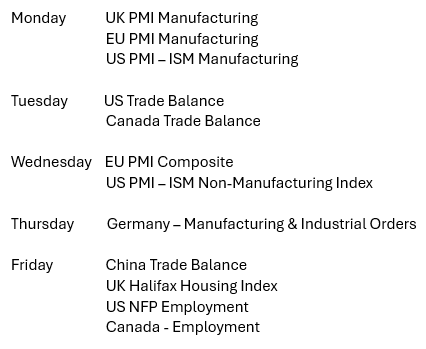
In the coming week, the key economic data releases and significant events include:
What’s in the news?
In these early days of the Burnham premiership, two contrasting opinion polls.
A More in Common survey points to a “Burnham bounce,” with Labour leapfrogging Nigel Farage’s Reform into first place after support jumped four points in just days. Labour is up four points to 28%Reform down two points to 24%, the Conservatives unchanged on 22%, the Liberal Democrats up one point to 12%, and the Greens down three points to 8%, with the SNP unchanged on 2%.
By contrast, the latest YouGov poll suggests Burnham’s Downing Street honeymoon could already be under pressure, with growing support for Opposition leader Kemi Badenoch. The polling shows the public split down the middle on the former Mayor of Greater Manchester, with 38% viewing him favourably and 35% negatively, a net score of +3. That makes him more popular at launch than Keir Starmer (-3), Boris Johnson (-18), or Rishi Sunak (-19), though he trails well behind Theresa May, who stormed into office in 2016 with a net rating of +12.
The bigger story in the tracker, however, is Badenoch’s rapid rise. Her net favourability score has climbed to -11, her highest rating ever recorded by YouGov, and the strongest showing for any Conservative leader in over five years. A third (33%) of Britons now view her favourably, up from just 19% a year ago, while negative perceptions have dropped from 54% to 44%, a sharp shift in momentum as voters take a closer look at No 10’s new occupant.
While Badenoch enjoys a significant polling breakthrough, the picture looks far worse for Reform UK leader Nigel Farage, whose approval ratings have slumped after he resigned to trigger a by-election in Clacton.
UK
London’s population shrank for the first time since the COVID pandemic, as more than 400,000 people left the capital in 2025 to move to other parts of the UK. All other regions in England saw their numbers rise, government data showed.
Although London recorded more births than deaths, and international migrants into the city outnumbered Londoners leaving the UK, the outflow was driven largely by people in their thirties and forties, many with children leaving the capital. London has been plagued by a cost-of-living crisis, slower pay growth, and higher unemployment than other parts of the country. The capital has also seen a sharp drop in student enrolments, causing more school closures and funding cuts.
Good news
The FTSE 100 capped off its best monthly performance since February, supported by gains across energy, defence, and select retail stocks. The index gained 3.53% in July 2026, touching a series of all-time intraday highs near 10,989 points.
This momentum was driven by a combination of strong earnings reports, rising commodity prices, and a global market rotation away from volatile technology stocks and toward defensive value assets.
Not so good news
Prime Minister Andy Burnham’s growing list of spending commitments could cost the Treasury as much as £63 billion by the end of the decade, piling fresh pressure on Chancellor John Healey as economists warn financial markets may have little appetite for significantly higher borrowing.
Analysis by Capital Economics estimates the Government’s recent pledges could require between £46 billion and £63 billion of additional spending by 2030 — equivalent to around 1.5% to 2% of GDP. The findings highlight the scale of the fiscal challenge facing the new Government just weeks before its first Autumn Budget, with ministers attempting to balance ambitious spending promises against already strained public finances.
Housing is another major pressure point. The Government has pledged to increase council house construction to levels not seen since before the Second World War — a policy Capital Economics estimates could cost between £12 billion and £23 billion. With social care, housing, defence, and cost-of-living support all competing for funding, Healey faces a choice between higher taxes, spending cuts elsewhere, or testing the confidence of financial markets. The Autumn Budget is now shaping up to be the first major test of whether the Burnham Government can reconcile its policy ambitions with the realities of Britain’s public finances.
UK 10-year gilt yields have risen to a near two-month high, with public debt close to £3 trillion — 94.9% of GDP, levels last seen in the early 1960s. Thirty-year yields remain close to the 28-year high of 5.822% set on 15 May; the 10-year closed the week at 5.038%, having started it at 4.97%.
The EY Item Club expects a “sustained period of weak growth,” with GDP growth slowing to 0.9% this year and 0.7% next, influenced by rising oil prices amid Middle East tensions. Healey’s fiscal headroom may have diminished significantly, potentially forcing tax increases or spending cuts in the Budget. Inflation is expected to peak at 3.5%, with unemployment rising to 5.5%.
The number of British millionaires has dropped to its lowest level in nearly two decades, as the property market slumps and high taxes under Labour drive people offshore. The ASI (Adam Smith Institute) estimates there are now 442,000 people in Britain with wealth over £1 million — down 7% on last year, and the lowest level since the 2008 GFC. Mitchell Palmer, from the think tank, called the shrinking millionaire population “a warning signal,” adding: “Every millionaire that leaves means less capital for British businesses, fewer international connections and weaker entrepreneurial spirit in the economy.”
BP has put its North Sea business up for sale after 60 years, in a move that will leave the British energy giant without any petrochemicals production in its home market for the first time in decades. The decision follows years of high UK taxation, reaching up to 78% and comes as new chief executive Meg O’Neill pushes a broader portfolio review to redirect spending toward higher-value opportunities elsewhere. BP currently remains one of the largest operators in the region, with stakes in roughly 20 fields.
The SMMT (Society of Motor Manufacturers and Traders) reported a slump in UK car industry output, with vehicle production falling 7.5% in the first half of 2026.
USA
A divided US Federal Reserve held interest rates unchanged at 3.50%–3.75% on Wednesday, with three members voting to increase, as the central bank navigates stubborn inflation and volatility in oil markets. Chair Kevin Warsh said there were no “magic wands” for dealing with five years of inflation above the bank’s 2% target, as the Iran war continues to drive up oil and energy costs, while tariffs and AI complicate policymakers’ decision-making. Markets are now pricing in a near 100% probability of a rate rise at the Fed’s next meeting on 16 September, a sharp shift from June, when the decision to hold was unanimous.
The US is imposing new tariffs of 10% to 12.5% on around 60 trading partners, including the UK, China, and the EU, from 19 August, over their failure to adequately address forced labour issues. Brazil faces 12.5%, while Canada faces up to 50%, prompting PM Carney to threaten a trade war with the US in return. The move follows a Supreme Court ruling that deemed previous tariffs illegal. US Trade Representative Jamieson Greer said the action would begin correcting what he called a human rights abuse and a distortive trade practice, with the Office of the US Trade Representative noting the latest tariffs now cover 99.4% of US imports. Economists have warned the measures may push up consumer prices, with legal challenges and retaliatory duties both anticipated.
The US economy grew more slowly than expected in the second quarter, as AI-related imports weighed on otherwise robust data. GDP expanded at an annualised rate of 1.5%, down from a revised 2.1% in Q1. Consumer spending picked up despite inflation, and AI-driven business investment remained strong — but the AI boom cut against headline growth, as the country imported more semiconductors. The economy has withstood 18 months of “policy-driven economic shocks” under President Trump’s second term, including tariffs and the Iran war’s energy crisis, better than economists expected.
The Conference Board’s latest monthly survey showed consumer confidence sliding in July, as Americans’ assessment of current business and labour market conditions fell for the third month running. The drop was steeper than forecast and painted a gloomier picture than the University of Michigan’s sentiment survey earlier this month, when Americans had appeared more optimistic on falling gas prices during a pause in the US–Iran conflict.
US oil inventories have fallen to precariously low levels as refiners ramp up activity to capitalise on soaring fuel prices. Refiners processed 17 million barrels of crude a day last week, the fastest pace since 2019 drawing down commercial stockpiles by 7.2 million barrels as exports to Asia and Europe increased amid renewed Middle East disruption. Analysts warned the drawdown could jeopardise the US’s role as global supplier of last resort.
The Wall Street Journal reports that major US cities are running out of children, with the under-18 population in large urban areas down 6% over the past decade, and under-fives down 15%. Families cite cost, safety, and quality of life as reasons for leaving. The trend isn’t confined to cities: the US has 1% fewer children overall than in 2016, and 7% fewer under-fives.
US measles cases have hit a 35-year high as vaccination rates fall. Still far short of pre-1990s levels, before widespread vaccination drove a sharp decline, this year’s 2,295 recorded cases already exceed all of 2025 and 93% of patients are unvaccinated. Measles is typically the first disease to resurge when vaccination dips, given how contagious it is; uptake has declined for years, and most US counties now sit below herd immunity thresholds.
The EU
Eurozone GDP expanded by 0.4% between the first and second quarters of 2026, the strongest pace since early 2025, suggesting the region has absorbed the recent energy shock relatively well. However, Eurostat’s flash estimate shows annual headline inflation picked back up to 2.9%, following a brief dip to 2.8% in June. Markets continue to price in close to two additional ECB rate rises before the end of the year.
German 10-year bund yields soared to a 15-year high, finishing July at 3.2087%.
Europe faces the risk of an imminent energy crisis as gas stockpiles fall to historic lows, with storage sites across the continent just above 50%, a historically low level for late July, according to energy consultancy Wood Mackenzie. Europe is now on track to enter winter with storage at 75% capacity, against a five-year average of 90%. Reserves have been run down by the war in Iran, which has disrupted a fifth of the world’s gas supply.
German carmaker BMW is preparing to cut around 8,000 jobs worldwide under a major restructuring programme, as the automotive industry grapples with rising costs, slowing demand, and intensifying competition from Chinese rivals. German newspaper Sueddeutsche Zeitung reported that one in every 11 jobs in Germany could disappear as part of the cost-cutting drive, with many of the reductions expected to fall on BMW’s Munich headquarters.
Germany’s Chancellor Friedrich Merz is in political trouble again, despite a major political reset. In July, he finally pushed through a reform package meant to fix Germany’s pension system, reboot the economy, and deliver a tax break for the middle class. Then Jens Spahn, the conservative party’s leader in the Bundestag, admitted fathering a child with his husband via surrogacy in the United States, a practice illegal in Germany, which Merz’s CDU/CSU has long insisted on keeping banned, citing moral and ethical grounds. Spahn resigned, triggering a fresh cabinet reshuffle. The upheaval is pure schadenfreude for the AfD, which leads the polls ahead of major state elections in September.
Australia
Speaking at the annual Annika Foundation event, RBA (Reserve Bank of Australia) Governor Michele Bullock said inflation remains above the central bank’s comfort zone, and that demand may need to ease further to bring price growth back within the 2%–3% target range. The RBA has already raised its cash rate three times this year, and Bullock stressed policymakers remain ready to act again if necessary. She highlighted risks from higher oil prices, cost pressures flowing through the economy, and weak productivity, while noting the impact on headline inflation has been less severe than initially expected.
The latest CPI (Consumer Price Index) data, released last week, showed annual inflation moderating to 3.8%. The softer-than-feared reading brought significant relief to mortgage holders, sharply paring back expectations of an imminent cash rate hike.
Recent employment figures showed a surprise surge of over 76,000 jobs created in a single month, continuing to demonstrate remarkable resilience in the national labour market.
Canada
Statistics Canada released its latest GDP data that showed that at the end of July, the economy expanded by 0.3%, topping consensus forecasts and signalling a solid rebound for the second quarter after consecutive quarters of sluggish activity. Growth was spearheaded by resource sectors, including mining, oil, and gas, alongside manufacturing and finance.
The BoC (Bank of Canada) signalled it remains in a holding pattern on interest rates. While energy market fluctuations and global inflation pressures linger, steady domestic growth is expected to keep the central bank on pause for the remainder of 2026.
In a major industrial update, the federal government greenlit a massive $70 billion critical minerals mine project in northern Ontario, reflecting Ottawa’s push to secure domestic supply chains for battery metals and EV infrastructure.
Others
China’s economy remains characterised by a growing divergence between a resilient external sector and subdued domestic demand. Official NBS data showed second-quarter GDP growth slowing to 4.3% year-on-year, from 5.0% in the first quarter, the weakest pace of expansion in more than three years. The slowdown was concentrated in the domestic economy rather than trade or manufacturing: industrial production accelerated to 5.3% YoY in June, and exports continued to outperform expectations, while retail sales rose just 1.0% and fixed-asset investment remained in contractionary territory, highlighting the continued drag from weak property activity and softer consumer demand.
China is leaning on technology and exports, rather than property and infrastructure, to support growth. The country’s trade surplus approached $1.2 trillion in 2025 and remains a key source of resilience, supported by strong demand for higher-value manufacturing, semiconductors, and technology-related exports. This strength is also reflected in the yuan, which has appreciated more than 9% against the US Dollar since the 2025 tariff shock, pointing less to dollar weakness than to improving confidence in China’s external sector and its ability to absorb external shocks.
China’s factory activity unexpectedly contracted this month, the first such contraction since February, underscoring the challenge facing Beijing as it seeks to kickstart a slowing domestic economy. The surprise PMI (purchasing managers’ index) reading, alongside GDP growth below official targets, represents what Commerzbank’s senior China economist called a “dual miss” that “intensifies pressure on Beijing” to deploy fiscal and potentially even monetary stimulus in the months ahead.
Urban unemployment among 16- to 24-year-olds hit 14.9% in June, the highest for that month since the government revised its methodology two years ago. A record 12.7 million graduates are entering the workforce this year, with economist Zhaopeng Xing forecasting youth unemployment will approach 20% within two months.
For more than a decade, Indian Prime Minister Narendra Modi has pursued one of the most ambitious industrial programmes attempted by any modern democracy. “Make in India” was never simply about creating jobs but a strategic effort to transform India from a nation known primarily for services into a manufacturing powerhouse capable of challenging China’s dominance over global supply chains.
When the initiative launched in 2014, the objective was straightforward: attract foreign investment, build domestic industry, expand exports, and create millions of skilled jobs for one of the world’s youngest populations. Since then, New Delhi has introduced production incentives across electronics, pharmaceuticals, automobiles, semiconductors, renewable energy, defence, telecommunications, and numerous other strategic industries.
India has become the world’s second-largest producer of mobile phones, after barely existing in that market a decade ago. Apple, Foxconn, Samsung, Tata Electronics, and numerous suppliers continue expanding production across the country, and the government this week approved a further ₹62,500 crore programme aimed specifically at increasing mobile phone manufacturing, exports, and employment, a clear signal New Delhi has no intention of slowing its industrial strategy.
Imports from China reached almost $80 billion in the first half of 2026, while India’s exports to China also rose sharply; manufacturing growth is itself increasing demand for Chinese machinery and industrial components. In other words, India is becoming stronger while simultaneously becoming more dependent on the world’s largest manufacturing base , which is how industrial revolutions usually begin.
The world appears to be entering an era where manufacturing is no longer concentrated in a single country, with production becoming increasingly regionalised as governments place greater emphasis on national security than maximum efficiency. India is positioning itself to become one of the principal beneficiaries of that shift. If it continues building its industrial base while strengthening domestic supply chains, the next great manufacturing story may not be about replacing China but creating the first genuine alternative to it.
The number of active businesses at the Dubai International Financial Centre has increased 30% over the past year, according to figures issued by the hub, the first time the register has reached five figures, building on 39% growth in 2025. The number of regulated financial services firms was up 16%, while AI, fintech, and “innovation” firms increased by 39%
Stranger than fiction
Water covers more than 70% of the Earth’s surface, but just 2.5% of the world’s water is fresh. That scarcity has made desalination, pulling salt and other minerals out of non-potable water to create fresh water for drinking or industrial use vital to communities in arid regions, from the Middle East to California. The trouble is that conventional desalination is energy-intensive, retains only around 30–40% of the water it processes, and is often powered by fossil fuels. The leftover brine is usually dumped back into waterways, where it can damage marine ecosystems.
Eden Tech thinks its novel approach could solve both problems, by making the process more efficient while turning waste into profit. Traditional desalination systems act as “high-pressure strainers,” using reverse osmosis to filter out salt by pushing water through a semipermeable membrane. Eden Tech’s system instead functions “like a salad spinner,” using centrifugal force to help separate salt from water. By employing natural forces rather than pressure alone, the company says its approach requires two to three times less energy than thermal systems, while retaining roughly twice as much water.
Eden also plans to extract valuable minerals such as lithium and rubidium, depending on the water source from the remaining brine, and sell them to create an additional revenue stream. That could both reduce costs for consumers and cut the amount of waste returned to the environment.
The company has raised $3.3 million in funding since launching in 2020 and hopes to scale its newly debuted Genesis machine for commercial use over the next year.
Quote
Morgan Housel, “All behaviour makes sense with enough information”.