
24/10/2026 by Tony Redondo
In the run-up to Wednesday’s Budget, the phrase doing the rounds in HM Treasury is “Budget and beyond”. The idea is that next week’s fiscal event is merely a staging ground. So, should we expect a radical, pro-growth Budget? I doubt it, despite Healey saying last week that he wants to back “bloody-minded entrepreneurs”, cut regulation and “back business in Britain making a profit”. He even admitted firms have been under “a lot of pressure” from employment law, regulation, higher taxes and strained global supply chains, some of it introduced by Sir Keir Starmer’s government.
Don’t get your hopes up. If Healey genuinely believed in the profit motive, he wouldn’t inflict windfall taxes on any sector, just because it’s doing well. British banks have been taxed harder than the rest of the private sector for around 15 years, a punishment for their part in the 2008 crisis.
I suspect this will be a completely conventional Labour tax-and-spend Budget, a staging post for Burnham to call an early election next year and stand on an outright socialist manifesto.
Healey faces a grim backdrop. Borrowing costs at a 30-year high, inflation at a year-high 3.5% thanks to the Iran war, record fuel prices and annual debt interest set to top £100bn. Get it wrong and Andy Burnham’s honeymoon as prime minister ends abruptly. And with a PM laser-focused on micro feel-good measures, Healey is under pressure to announce something, anything, positive on Wednesday.
The Treasury has already briefed some sweeteners for business, including extending import tariff suspensions on more than 250 goods.
The real tests will be the reaction of the bond markets and the OBRs (Office for Budget Responsibility) judgement, also out on 28 October. Migration could play a big role on the day. Previous forecasts overstated migration’s contribution to GDP because they ignored the lifetime fiscal cost of newcomers and whether they were in high- or low-paid jobs. Next week’s outlook could correct that. More importantly, if the OBR downgrades its near-term net migration forecasts, there is a fiscal hit too. On its own numbers, roughly £5bn less headroom for Healey. Britons might still be better off in that scenario, with higher GDP per head.
Analysts also expect the OBR to flag extra pressures not captured in the central headroom figures like the trajectory of defence spending, welfare, and planned efficiencies by 2029.
Then there’s the Jackdaw gas field in the North Sea, finally approved last week. Long overdue and welcome, but it won’t do much to stop a forecast 16% rise in energy bills and widespread fears of a dark winter.
Whether Healey’s Budget is built on sand or concrete comes down, to paraphrase Andy Haldane, to one question: is it a Budget for the bond markets or for the Labour backbenchers? If he wants to reassure the markets, he must at least signal that significant welfare cuts are coming.
Haldane thinks Burnham has it in him to be a great prime minister. The former Bank of England chief economist and current President of the British Chambers of Commerce calls himself a “critical friend” and informally advised Burnham throughout his time as mayor of Greater Manchester. He has high hopes but says tough choices on spending must come now or the consequences will be dire.
His core concern is that the government doesn’t grasp how precarious Britain’s finances are. “The penny has not yet fully dropped, including in Downing Street,” he says. “You see that in us having the highest borrowing costs in the G7, despite not having the highest debts and deficits.”
A new paper from the Centre for Policy Studies (CPS) makes concerning reading. The Tax Foundation’s 2026 International Tax Competitiveness Index ranks the UK 30th out of 38 OECD countries. It measures how pro-growth a tax system is, not the size of the burden. The CPS modelled two changes the chancellor has been urged to consider and finds both harmful:
- CGT aligned with the 45% income tax rate: this would give the UK the highest CGT rate in the OECD, above Denmark’s 42%. HMRC estimates previously highlighted by the CPS show a 10-point rise in the higher rate would cut revenue by £3.6bn after three years — a few taxpayers account for most CGT receipts, and many would simply hold on to their assets rather than sell.
- A wealth tax: this would drop the UK from 33rd to 38th on property taxation — the worst place in the OECD to own property or assets — and from 30th to 35th overall. Only four OECD countries have a full wealth tax and three a partial one. They discourage investment and entrepreneurship and raise little. Spain’s raised just 0.21% of GDP.
The UK is strongest on cross-border taxation, where it ranks first. Elsewhere: 25th on corporate, 22nd on individual, 33rd on property and 34th on consumption taxes. The VAT base covers just 46% of consumption against an OECD average of 55%, and our £90,000 VAT registration threshold is far above the OECD average of nearer £40,000.
The Laffer Curve strikes again. Rachel Reeves’s stamp duty increase has backfired after tax receipts from property sales above £5m fell by £541m in the 18 months following her 2024 budget when she raised the second-home stamp duty surcharge to 5% according to data from estate agents Knight Frank. It’s not just the stamp duty that is lost but also the economic activity that accompanies the property transactions.
Finally, the IEA (Institute of Economic Affairs) has published an “alternative” Budget. It argues it takes surprisingly little to balance the books. Core state functions such as defence, policing and the courts account for a small share of spending. Welfare is huge and growing, so freezing it in cash terms and then trimming 0.85% a year to the end of this Parliament would, alongside the IEA’s tax proposals, bring the current budget into surplus.
The IEA’s bottom line: Britain has choices. A surplus needs only small changes and paired with a better tax system and pro-growth measures, we could have stronger growth and healthy public finances.
Currency Exchange Rates Update
It’s been a superb week for the Pound, rising 0.7% against the Euro to hit its highest level since May 2025.
Higher than expected UK wages and inflation data this week have sharply increased the odds that the Bank of England will raise UK interest rates when they next meet on the 5th of November. UK rates have been stuck at 3.75% since December 2025. On the other side of the channel, the benchmark 10-year French bond yield hit and remains at its highest level since 2002 as the spread between French and German government bond yields widened to over 170 basis points, the highest level in 15 years amid mounting concerns over France’s fiscal outlook.
The Pound edged higher against the US Dollar and has now gained over 1.1% in the last 30-days against the greenback.
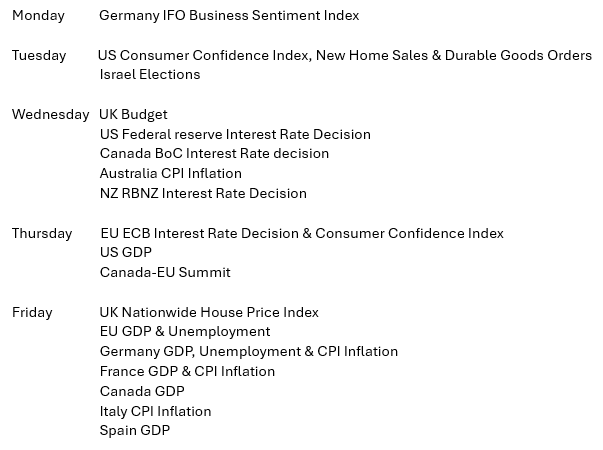
With the UK Budget and interest rate decisions from the Fed, ECB and the Bank of Canada due this week, it’s going to be another lively week in the markets.
In the coming week, the key economic data releases and significant events include:
What’s in the news?
UK
Official figures out last week showed the UK government borrowed £24.5 billion in September with almost £11 billion of it going on debt interest. That’s more than £390 per household on debt service in a single month.
Across the financial year so far, April to September, debt interest has cost £61 billion. That’s six months of simply servicing our national debt, not paying any of it back, and not building, growing or developing anything. It’s equivalent to the UK’s entire annual defence budget.
Put it another way. £61 billion is what you’d raise in a year by adding a whopping 8p to the basic rate of income tax. It would build around 40 large, state-of-the-art hospitals, or employ more than 100,000 extra nurses for ten years.
That’s the interest bill on Britain’s spiralling national debt, now more than £3 trillion, for just six months.
A new report from the Centre for Policy Studies says Andy Burnham has the chance to open the door to at least 4.2 million new homes by releasing targeted areas of green belt that don’t serve its fundamental purpose. ‘The Future of the Green Belt’, by Robert Colvile and Dr Samuel Hughes, is built on a full spatial survey of England’s 16 Green Belts carried out by Create Streets, the most complete study yet of the type and quality of green belt land. It identifies swathes of previously developed or low-quality land within a 15-minute walk of existing railway lines.
The headline numbers: England has 33,000 hectares of unprotected low-quality agricultural land and 115,000 hectares of unprotected medium-quality land near existing rail infrastructure. Developed to the Government’s minimum density, that’s enough for almost 700,000 homes and 2.4 million homes respectively, more if ministers restored the density standards in the previous version of the planning framework.
In the London green belt alone, there’s room near existing railway infrastructure for an additional 1.1 million homes at low suburban densities.
Good news
The BIST (Department for Business, Innovation, Science and Trade) has updated its quarterly trade figures. UK exports were worth £949.4bn in the 12 months to August 2026, up 5.4% on the same period a year earlier. Services led the way, up 6.6%, while goods exports rose 4%. The EU remains our biggest export market, taking 41.3% of UK exports (goods and services combined) in 2025, followed by the US on 21.8%One caveat: these are changes in value, not volume. Value-based growth of 5.4% looks less impressive if inflation is doing the heavy lifting.
After years of delay and false starts, the government has finally approved the Jackdaw gas field in the North Sea. Energy Secretary Miatta Fahnbulleh says she has given the project the green light and that it will “supply the UK with gas from this winter”. It’s a sizeable project. At full capacity, Jackdaw will account for 6% of all North Sea gas production. Next on her desk is a far more contentious decision: Rosebank, the oil field the government has yet to approve.
Not so good news
CPS Research Fellow Tim Dier thinks the Government should stop using PuFins as a substitute for a genuine growth strategy. His case: curb their growth, wind down or sell their portfolios, and use the proceeds to repay debt. When the Government changed its headline debt target in October 2024, it did more than tweak an accounting rule. By switching from public sector net debt (PSND ex BoE) to public sector net financial liabilities (PSNFL), ministers created a powerful incentive to channel state money through Public Financial Institutions, or “PuFins”, publicly funded bodies that lend, take equity stakes and issue guarantees in the name of “crowding in” private capital. Had the old target been kept, the October 2024 Budget would have broken the Government’s debt rules by £5.8 billion. Under the new one, it passed with £15.7 billion to spare. And the PuFins are growing. The four main bodies, the National Wealth Fund, the British Business Bank, UK Export Finance and the new National Housing Bank have announced capacity of close to £200 billion. That excludes the Student Loans Company and the National Wealth Fund’s separate loan of up to £36.6 billion to Sizewell C. Dier says we have been here before. Under the Private Finance Initiative, accounting treatment that kept borrowing off the books shaped how the state invested and taxpayers are still paying the price. Worse, the taxpayer isn’t getting a good deal. At best these bodies breakeven; in the early years they cost up to £2 billion a year net, before running costs. The National Wealth Fund, for example, is targeting a 4–6% return on equity by the mid-2030s. With 10-year gilt yields at around 5.4%, the bottom of that range wouldn’t even cover its cost of funds. Meanwhile, the Government picks the sectors that receive investment and, increasingly, the parts of the country where it goes.
UK inflation rose from 3.1% in August to 3.5% in September, above the 3.4% economists expected. That is its highest level in almost a year, driven by higher petrol and diesel prices linked to the conflict in the Middle East. Services inflation increased to 3.7%; core rose to 2.8% and factory input costs jumped 8.3%, all adding to worries about persistent price pressures.
Add stronger wage growth and the Bank of England is expected to raise its base rate from 3.75% to 4% when it meets on 5 November. Surging fuel costs and higher winter energy bills threaten to prolong the squeeze on households.
Job vacancies fell below 700,000 for the first time in over five years, a clear sign of weakening. The unemployment rate dipped slightly to 4.7%, and wage growth continued to slow. Even so, annual growth in employees’ earnings excluding bonuses was 3.7%, ahead of the 3.6% economists expected.
Public debt topped £3 trillion in September for the first time in official data, just before John Healey’s Budget. Borrowing also overshot expectations. The milestone sums up the difficulties facing the Chancellor ahead of his maiden fiscal statement: debt has climbed rapidly over the past six years, having first exceeded £2 trillion in June 2020. As a share of GDP, it now stands at 94%.
Retail sales fell 0.4% in September, far worse than the 0.1% fall the City forecast. Firms reported lower sales and footfall as customers cut back on non-essentials. GfK data shows consumer confidence suffered its biggest fall since the Brexit vote in 2016.
Ofgem has warned, for the first time ever, that it cannot guarantee demand will be met on a peak winter day.
UK credit card balances hit a record high. Average active balances passed £2,000 in August, according to FICO. Payment rates fell after a brief recovery, and average spending rose 3.1% month-on-month to £840. The average credit limit crossed £6,000 for the first time. One-cycle delinquency dipped slightly but remains 5.1% higher year-on-year. With inflation climbing, lenders’ risk teams need to watch payment stability as seasonal pressures loom.
EY-Parthenon reports UK-listed companies issued their highest number of profit warnings in nearly two years in the third quarter, as rising costs, geopolitical turmoil and weakening demand piled pressure on earnings. There were 65 warnings in the three months to September, up from 59 the previous quarter and the most since the final quarter of 2024, when there were 71.
USA
The Treasury’s monthly statement is out, and the US federal government has closed fiscal year 2026 (ended 30 September) with a deficit of $1.99 trillion. That’s the third largest ever recorded. The deficit grew 8% on the year, the fastest rate of growth since 2023. Last year’s was $1.84 trillion, a touch under 2024’s $1.95 trillion.
It’s the 25th consecutive annual deficit. The last surplus came in fiscal 2001, in nominal dollars. America now looks locked into perennial mega-deficits, exceeded only by the Covid lockdown years. Tax receipts, meanwhile, have been largely stable.
Here’s the bit that matters: the US is now spending more than $1 trillion a year just paying interest on money it has already borrowed. Total spending climbed to $7.4 trillion against revenues of only $5.4 trillion, leaving a deficit $217 billion bigger than last year’s. But the real worry is buried inside that spending bill — net interest of $1.05 trillion, with gross interest at $1.36 trillion. That’s roughly $2.9 billion every day in net interest, and not a cent of it reduces the principal.
Interest now exceeds the entire defence budget. It’s the third-largest line in the federal budget behind Social Security and Medicare, ahead of Medicaid, veterans’ benefits and a long list of other programmes. Interest costs rose 8% on the year; revenue rose 3%. Washington collected more from taxpayers, yet the cost of servicing its debt grew nearly three times as fast. Roughly 19 cents of every dollar collected now goes on net interest. Yes, interest is income to bondholders, including pension funds, and some flows back via the Fed. The pain point is what happens as cheap debt rolls over at higher rates.
Yesterday’s borrowing demands today’s taxes; today’s borrowing guarantees a bigger interest bill tomorrow. The politicians aren’t solving the debt problem but financing the cost of refusing to solve it.
Politics. Polls and commentary point to strong Democratic momentum ahead of the 3 November midterms, with forecasters flagging a possible flip of the House and a tight fight for the Senate. Immigration enforcement tactics, inflation and federal policy are driving sentiment in the battleground states.
Markets. US and global equities came under sharp pressure, led by a pullback in mega-cap tech and AI. The worry: enormous capex budgets for data centres and semiconductors, set against revenue that keeps arriving later than promised. The Dow shed over 652 points, or 1.23%, on Friday, a wobble, not a rout.
Crude climbed to multi-month highs, with Brent topping $116 a barrel, a six-month high. Dearer energy, transport and inputs pushed US firms to raise selling prices at the fastest pace in over four years. S&P Global’ s flash US Composite PMI showed activity still near multi-year highs despite a slight cooling. Demand and orders picked up, but supplier delays, logistics bottlenecks and cost inflation persist.
The EU
Eurozone inflation averaged 3.8% in September, a big jump, driven principally by energy, which rose a whopping 18.9%. Strip out that hike and inflation would be 2.3%, which would let ECB policymakers sit on their hands this Thursday. But setting rates in this environment is harder than it looks, because inflation is so uneven across the bloc: Germany 3.3%, France 3.4%, Italy 4.2% and Spain 5.0%.
Which G7 country goes bankrupt first? The ‘finger’ is pointing firmly at France. Can’t print euros. France, the biggest default risk in the G7 with debt of 119% of GDP, around half of it owed to foreigners, and a deficit of 5.4% of GDP. It pays 1.9% on old debt but 4.9% on new, with massive refinancing due. Can’t print euros so the risk of default keeps growing.
The benchmark French 10-year yield is now 5.11%, above 5% for the first time since 2002 and markets are demanding 173 basis points over German Bunds to take French risk, a 15-year high. Three things are driving it:
- Political uncertainty due to weak leadership and the April 2027 presidential elections
- France’s indebtedness (119% of GDP) and its reluctance or inability to tackle it, and
- A colossal 55% of French government debt is held by non-French investors. That’s a real risk, not just to France but to the whole EU, which may soon need intervention at a supranational level.
Investors are now asking whether France’s problems will spread. The spread over Bunds has hit levels not seen since the eurozone debt crisis, the cost of insuring French debt against default is at the same highs, and the euro is down 6.6% against the dollar and 3.9% against the Pound this year.
The real fear is fragmentation. Countries sharing a currency facing wildly different borrowing costs, which feeds on itself.
Which brings us to Christine Lagarde, the President of the ECB (European Central Bank). In March 2020 she said it wasn’t the ECB’s job to “close the spread”. Italian yields spiked, she recanted within hours, and the ECB launched emergency bond-buying with “no limits”. In 2022 she created the TPI (Transmission Protection Instrument) to stop indebted members being punished against their frugal neighbours. The mere announcement was enough. It has never been used. Now it’s the centre of a fevered debate. Will the ECB bail out France?
Lagarde, a former French finance minister faces the press at the same Frankfurt podium on Thursday. Her term runs to October 2027, but she’s being touted as the next head of the World Economic Forum. An early exit would spark a north-versus-south scrap for the job, with Klaas Knot, a Dutch central banker, the Spaniard Pablo Hernandez de Cos, and François Villeroy de Galhau, a former governor of the French central bank the early names.
The French private sector had its worst month since July. The PMI slid from 51.1 in September to 48.4 in October, a four-month low and below the 50 line that separates growth from contraction. Business expectations are at their lowest in over six years.
Then there are the riots. France Assureurs estimates 3,000 shops have been damaged or destroyed so far. Brave words from the insurers about standing foursquare behind shopkeepers, but a deafening silence on lost trade, what it will cost the industry, and whether the State will chip in. Most policies require claims within five days, and lost trade is very hard to quantify with fresh unrest expected. As a yardstick, the summer 2023 riots produced 17,000 claims and €793 million in costs.
And it has spread to Italy. Giorgia Meloni’s government is sending 500 soldiers with police powers into Milan after violent unrest left shopfronts smashed, businesses looted and officers injured. What began as a peaceful demonstration over the cost of living and poor public services turned violent: more than 270 detained, around 80% of them reportedly minors, and 14 injured. For Milan, Italy’s financial capital and a luxury shopping destination whose reputation rests on fashion, tourism and commerce, the damage goes beyond the streets. Businesses are now bracing for more.
Australia
The Australian Dollar had a strong week, up 0.89% against the Pound, 1.57% against the Euro and 1.26% against the US Dollar after RBA (Reserve Bank of Australia) Deputy Governor Andrew Hauser warned that Australia’s inflation outlook has become “materially worse”. Hauser conceded that further tightening would be painful but signalled it may be necessary to stop higher inflation expectations becoming entrenched.
Treasurer Jim Chalmers echoed the warning, saying persistent inflation and prolonged high interest rates will mean softer GDP growth and higher unemployment. Recent figures show modest job growth, but soft indicators point to a cooling labour market heading into year-end. State-level pressure is already showing. Victoria’s unemployment rate has climbed to 5.1%, and household sentiment remains historically weak. Rising costs in core sectors like healthcare and education, plus high energy prices, continue to squeeze consumer purchasing power, and markets are braced for further tightening.
With the Melbourne Cup Day rate decision less than two weeks away, on 3 November, markets are pricing a 57% chance of another hike despite the softening economy.
Independent Federal MP for Indi, Helen Haines, was critically injured and required emergency leg amputation following a deliberate car attack outside her electoral office. Prime Minister Anthony Albanese and political leaders across the spectrum strongly condemned the attack, sparking nationwide debate and tighter security for political representatives and public figures.
Canada
Prime Minister Mark Carney has dismissed US claims, including from US Ambassador to Canada Pete Hoekstra, that Canadian officials are interfering in the upcoming midterm elections. Speaking from Istanbul, Carney said there was “no merit” to the allegations and voiced disappointment at accusations with nothing to back them up. With cross-border sensitivities running high ahead of November, Canadian diplomats have been told to steer clear of candidate events and direct engagement with midterm contenders.
Last Tuesday, the Parliamentary Budget Officer cut Canada’s GDP growth forecasts: 2026 down from 1.1% to 0.9%, and 2027 from 1.6% to 1.5%. The culprits are familiar: trade disruption, new US tariffs and Canada’s retaliatory tariffs. Elevated energy prices will keep inflation around 2.8% in 2026 before it eases to 2.4% in 2027. Meanwhile, new spending measures more than offset revenue gains, leaving annual federal deficits roughly C$3 billion higher over the next five years.
There was a little better news from the Bank of Canada’s Q3 Business Outlook Survey. Business sentiment ticked up modestly despite persistent cost pressures, and fewer firms are budgeting for a recession than earlier in the year.
Alberta is staying in Canada. Voters in the oil-rich western province decisively rejected taking steps towards independence: 76% voted to remain, 24% to start a secession process. The result mirrored the polls throughout the campaign and is a serious blow to the separatists, some of whom had predicted as much as 55%.
The more important results may be in the nine other referendum questions, which have had far less attention:
- Tighter borders. More than half of Albertans backed new provincial powers to limit immigration.
- Restricted services. A similar number supported limiting publicly funded services for non-citizens and non-residents, and imposing waiting periods or extra fees on temporary residents seeking health benefits.
- Voter ID. An even clearer majority, roughly 63%, backed requiring a passport, birth certificate or citizenship card to vote in provincial elections.
The immigration proposals will have to be negotiated with Ottawa, which is likely to stoke tension between Premier Danielle Smith and Carney, just when he is trying to present a united front in the tariff war with the US and the negotiations with the EU.
The separatists have vowed to press on regardless. Smith’s United Conservative Party holds its convention in November, and polls show just over half of its members support separation.
Others
China’s September-quarter GDP surprised to the upside, 4.5% year on year, ahead of the 4.4% forecast and up from 4.3% the previous quarter. Quarter on quarter, growth came in at 1.2% against an expected 1.0%. Exports and factory output did the heavy lifting, with AI-related demand continuing to prop up manufacturing. But the recovery is lopsided. Domestic demand and consumer spending remain weak as stronger production and exports have yet to feed through into a broad-based improvement. Exports tell the story: up 36.3% year on year in September, smashing forecasts of 25.7%, driven largely by booming AI-related electronics shipments. That surge is stoking trade tensions, particularly with the EU, where China’s surplus has reached almost €1bn a day, and prompted a quota deal on Chinese hybrid vehicle imports. At home, conditions remain subdued. Growth is below target, and consumer and producer prices are rising on elevated energy costs linked to the Middle East conflict.
Gulf economies as a whole are expected to shrink 4.8% this year, almost matching the COVID-19 shock with non-oil output receding in four countries. “This conflict has disrupted energy production, shipping, tourism, trade, and confidence,” Jihad Azour, director of the IMF’s Middle East and Central Asia Department, told reporters in Dubai.
Oman is the outlier, having pushed through economic reforms before the war and emerged relatively unscathed. Bahrain, the smallest Gulf oil exporter, has been hit hardest. It has long leaned on its neighbours to prop up its economy. With debt above 150% of GDP and foreign reserves down 50% since March, the kingdom is reportedly in talks for a cash infusion led by the UAE, according to Asharq Bloomberg.
Meanwhile, Gulf finance hubs have attracted firms controlling $5.8 trillion since the Iran war began in late February, a sign that some of the world’s biggest investors are betting the region’s sovereign wealth funds and family offices will remain major sources of cash. Abu Dhabi was the clear winner on both number of companies and scale of investment. The self-styled “capital of capital” drew firms managing over $5 trillion. Dubai, long the region’s main finance centre, came second with $670 billion. Riyadh and Doha also gained, but many firms entering Saudi Arabia have opened offices elsewhere in the Gulf first, usually the UAE.
Dubai’s economy is feeling the ripples of the Iran war, but only just. GDP fell 2.3% in the first half as the war closed airspace, rerouted trade and kept tourists away. For a city built on the movement of goods and people, though, the damage was cushioned by sectors sustained largely by its residents: aviation, with traffic through Dubai’s airport climbing every month since April, and finance, which grew 8.8%. Healthcare spending rose 14.3%, faster than any other sector, suggesting residents have stayed, or returned, during the war’s worst months so far.
In Brazil, polls show President Luiz Inácio Lula da Silva and rightist challenger Flávio Bolsonaro effectively tied ahead of Sunday’s (25 October) presidential runoff, with the result potentially coming down to whose supporters stay away from the ballot box. Whoever wins faces a tricky balancing act between China, Brazil’s biggest trading partner, and the US.
The last seven elections across Latin America have been won by conservatives friendly to Washington and its crackdown on immigration and drug trafficking. Either way, the winner inherits the same economic problem: a worsening fiscal outlook, growing difficulty servicing the debt, and rising economic precariousness for much of the population.
Stranger than fiction
Deforestation in the Brazilian Amazon is at its lowest since satellite records began in 1988. Forest loss between August 2025 and July 2026 was down 41.8% on the year, more than 1,000 km² under the previous record low, set in 2012. The Cerrado fell too, to its lowest since records began in 2001.
London’s super sewer has cut the amount of raw sewage going into the Thames by 86%. The 25 km Tideway tunnel, begun in 2016 and fully connected in 2025 let through just under three million cubic metres of storm overflow in 2025, against a pre-tunnel average of more than 21 million. The share of days with an elevated health risk fell from 76% to 10%.
We’ll soon have a spacecraft orbiting Mercury. In October 2018, the European Space Agency and the Japan Aerospace Exploration Agency launched BepiColombo, with one goal: get into orbit around Mercury. It’s far harder than you’d imagine. Heading towards the Sun is all downhill. A spacecraft falling inward speeds up the whole way and would reach Mercury far too fast for the little planet’s gravity to catch it. Braking with thrusters alone would need so much fuel that the spacecraft would be too heavy to launch. So instead, it sheds speed by swinging past other planets and handing a bit of its energy to each one, a trick worked out by the Italian mathematician Giuseppe “Bepi” Colombo, after whom the mission is named. Nine flybys later, one of Earth, two of Venus and six of Mercury and BepiColombo is nearly there, and about to split in two so both halves can observe Mercury at once. Europe’s Mercury Planetary Orbiter will focus on the planet itself, mapping its terrain and the minerals in its crust, while Japan’s Mercury Magnetospheric Orbiter studies its thin atmosphere and weak magnetic field.
A UK museum has been accused of “woke madness at its most ridiculous” after removing its Egyptian mummy exhibition because it does not have “consent from the deceased individual”. Visitors to the Kelvingrove Art Gallery and Museum in Glasgow found signs explaining that managers had “removed human remains from this display as a mark of respect”. The items removed include a coffin containing the remains of Nekht, a priest; a mummified right hand recovered from the Valley of the Kings in Luxor, Egypt; and a mummified male head and right foot.
Kelvingrove, which opened in 1901 and attracts more than 1.3 million visitors a year, has long featured Egyptian mummies and other remains in its ancient Egypt galleries — among the most popular exhibits in the museum. The Ancient Egyptians mummified their dead because they believed the body had to remain intact for the afterlife. Museums across the world have displayed mummies for generations.
Quote
Ernest Hemingway’s 1926 novel ‘The Sun Also Rises’: “How did you go bankrupt? Two ways. Gradually and then suddenly.”