
31/10/2026 by Tony Redondo
Inadequate. Insufficient. Deficient. Lacking. Incomplete. Scant. Paltry. Incompetent. Ineffective. Subpar. Flawed. Lame. Feeble.
Just some of the words thrown at John Healey’s first Budget on Wednesday, and Labour’s third since taking power in 2024.
Healey served up comforting language: “breathing space for today, fresh hope for the future”. The professionals disagreed. The OBR (Office for Budget Responsibility) laid out stagnant living standards, a collapsing savings rate and mortgage costs swallowing the biggest share of income in almost 20 years. Plenty of policies, nothing to change the trajectory. Every major decision ducked.
Healey called a million NEETs (young people not in employment, education or training) a scandal and said his government wouldn’t tolerate the waste of lives. Yet the OBR says his income tax and National Insurance threshold freeze, now running until 2031, will shrink the workforce by the equivalent of 215,000 full-time workers.
https://www.ftadviser.com/content/b1b352f4-2842-41eb-b44b-27d311765b6a
Then the big promise, a welfare white paper next year: “We will bring down the welfare bill.” Brave, given spending is rising faster than anyone thought. In March the OBR had it reaching £406.2bn by 2031, 11% of GDP. The new figure is £413.1bn by the end of the decade, almost £7bn higher, and north of £430bn a year in the early 2030s. If claims keep this pace, the bill will be £25bn a year higher by the start of the next parliament. Paying for that means a tax rise on the scale of Rachel Reeves’s National Insurance raid.
Sticky inflation and repeated tax raids have this parliament on course to be the worst on record for living standards. The OBR expects people to be poorer this year, real household disposable income barely growing thereafter, and zero real earnings growth for the next two years. The Resolution Foundation says the average Briton is already £420 poorer than when Labour took power. The Joseph Rowntree Foundation, using a broader measure that counts housing costs, predicts a £450 fall in annual household disposable income over this parliament, the biggest drop on record.
The OBR’s verdict? Labour is doing the opposite of making work pay.
Growth downgraded from 1.6% to 1% in 2027. Inflation above 3% for two years. Unemployment forecast above 5% next year. In the OBR’s own words, “no growth in real earnings in 2027 and 2028”. We’re getting poorer. Meanwhile the tax burden hits another record, 42.9% of GDP by 2030, with public spending at 45.7% in 2027.
One number Healey never mentioned: from April, the National Living Wage rises to £13.21 an hour — £27,477 a year for a 40-hour week. The 40% higher-rate threshold stays frozen at £50,270 until April 2031. Earn just 1.8 times the minimum wage and you’re a higher-rate taxpayer. That band was built for the top 3.5% of earners. Today a skilled tradesperson, an experienced nurse or a police sergeant hands over 42p of every extra pound (40% tax plus 2% NI), or 51p with a student loan. That one freeze quietly lifts an extra £34 billion a year from working people’s pay packets with no headline tax rise required.
“Breathing space” or “asphyxiation”?
The OBR also singled out Labour policies that make things worse. Angela Rayner’s Employment Rights Act will have a “negative economic impact”, with higher labour costs that “more than offset” any productivity gain.
The manifesto pledge of 1.5m new homes is dead and buried. The OBR has cut its forecast by another 190,000; a million by 2029 now looks like the ceiling. It blames not planning but taxes and regulation like the building safety levy, biodiversity net gain, nutrient neutrality and the rest, each adding “cost, complexity and timescales”.
Meanwhile UK energy costs are among the highest in the world: the highest industrial electricity prices in the G7 and the second highest residential prices after Germany. The cost of employment has risen faster than anywhere else in the developed world over a decade, and the cost of capital is the highest in the G7.
On energy, Healey promised to “draw a line in the sand” on a policy that has failed billpayers for years. Cheap power is now the priority, a welcome volte-face from the Miliband era, with a new test for clean energy projects: they must lower bills. Welcome, but too late to matter this decade. Every project generating power before 2030 is already signed off, price guarantees included.
One of the fastest-rising costs is government itself. The tax take passes its all-time high next year and keeps climbing. This Budget cut next to nothing; if anything, spending is higher, which means almost £6bn more borrowing than forecast this year and £4bn next. Debt interest is heading for £160bn, four times its pre-pandemic level.
Andy Haldane, former Bank of England chief economist and now President of the British Chambers of Commerce, sees nothing to narrow the “credibility gap” with the bond market. He scored the Budget four out of ten for failing to protect the public finances and put the odds of a worse economy next year at 50%.
Gilt yields remain the highest in the G7: slow growth, high debt, inflation vulnerability.
Currency Exchange Rates Update
The Pound finished October at its highest level against the Euro since March 2025, up more than 3.2% since 25 September.
Two main factors are at play. First, the carry trade. The Pound enjoys a clear advantage, with Bank of England base rate at 3.75% against the ECB’s 2.5%.
The ECB held rates on Thursday. The BoE meets this Thursday (5 November), and the nine-member Monetary Policy Committee (MPC) that sets UK rates is expected to move from a 6–3 vote to hold in September to a 6–3 vote to hike by 0.25% to 4%. That would widen the Pound’s carry advantage over the Euro further, and it would be the BoE’s first-rate rise since last December.
Second, French stress. The gap between French and German ten-year borrowing costs, the favoured measure, sits near 175 basis points and is closing in on the 2011 high of 190. The French budget vote on 17 November is the next test.
Sterling also hit a six-week high against the US Dollar on Friday. The Federal Reserve held rates at 4% on Wednesday, so a BoE hike on Thursday would bring UK rates level with US rates.
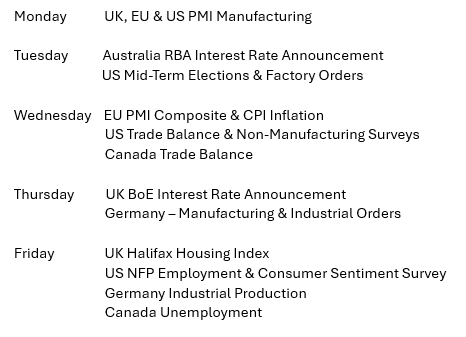
In the coming week, the key economic data releases and significant events include:
What’s in the news?
UK
Political uncertainty in Britain is fuelling a surge in bets on an early general election, and the bookies are paying attention. Odds on a vote before the end of the year have shortened from 20/1 to 10/1, as punters pile in on the prospect of a return to the polls amid continuing turbulence in Westminster. The headline figure: 77% of punters are backing an election before the year is out. But don’t get carried away. Bookmakers still make a contest in 2029 or later the single most likely outcome, at even money (1/1). That’s the gap between speculation about an imminent showdown and the more boring expectation of a parliament running its full course.
Betting markets make a handy barometer of public appetite for change, but a barometer isn’t a forecast. Whether this turns into an early election is another matter entirely.
Good news
There was good news in the budget, for savers with Healey’s decision to U-Turn on the Cash ISA Limit. The limit remains at £20,000, avoiding additional complexity for individual investors.
Not so good news
Britain faces its worst decade for household income growth since records began in the 1950s, with typical disposable incomes up just 2%, according to the IFS (Institute for Fiscal Studies). It dismissed Healey’s Budget as “unhelpful fiddling”. Director Helen Miller was blunt: “No amount of temporary cost of living packages will fix that. We need a stronger economy.”
The CBI was no kinder. Rain Newton-Smith said the Budget lacked “the bold moves that would have made it easier for firms to invest, hire and grow”, and offered nothing meaningful on energy bills.
Healey calls his bank surcharge hike “time-limited”. The City of London is already preparing for the next fight, and with good reason. Few things in British politics last longer than a temporary tax. The energy profits levy arrived in 2022 at 25% with a strict December 2025 sunset. Within months, 2028. Labour has since pushed it to 2030 and raised the rate. Income tax began in 1842 as a three-year emergency measure.
The Budget document insists the surcharge “will not be extended”. Nobody is reassured. Lloyds finance chief William Chalmers said: “We hope this tax rise is limited”, adding that it was unhelpful for growth. UK Finance’s David Postings said: “History gives us reason to be cautious”, and reminded ministers that international firms weigh a stable, predictable tax regime when deciding where to put capital and jobs.
The surcharge doubles to 6% for 15 months, raising an extra £1.5bn and taking receipts to £2.4bn for 2027-28, up from £1.2bn last year. RBC reckons NatWest, Nationwide and Lloyds are most exposed. Jefferies puts the cost at around 0.5% of market value if it genuinely is time limited.
JP Morgan went further, saying that singling out the sector again “lacks principle” and ignores a fiercely competitive global market. It insists it’s “committed” to the UK, with around 23,000 staff and 2.5m Chase customers. But the £3bn Canary Wharf tower is the pressure point. Jamie Dimon has already warned it could be reconsidered if the government turns “hostile”, and that sector-specific taxes have “adverse consequences”.
Mortgage approvals fell to 53,443 in September, the lowest in nearly three years, as rates rose on the back of the Middle East conflict. Remortgaging rose to 42,600, while net consumer borrowing dropped to £1.9bn, a three-month low. KPMG’s Katie Clinton said there is “little good news on the horizon”, with inflation outstripping private sector pay and the base rate expected to rise.
Nationwide has house price growth at 0.5% year on year in October, down from 0.8% and the weakest since January 2024. Chief economist Robert Gardner expects further softness, with new buyer enquiries still weak.
Poundland has filed a notice of intention to appoint administrators, putting 12,000 jobs at risk. The filing gives it temporary protection from creditors while advisers explore a sale of the brand and hundreds of stores. Preserving it as one business looks unlikely now that owner Gordon Brothers has rejected a takeover bid from Martin Property Group. Poundstretcher, B&M and Lidl are reportedly eyeing some of its roughly 600 stores. Managing director Barry Williams called the situation “unexpected, unwanted and wholly avoidable”, blaming funding restrictions imposed by Gordon Brothers, which bought Poundland from Pepco for a nominal £1 last June.
Ofgem wants landlords legally responsible for telling suppliers who their tenants are, so bills can be pursued directly. Get it wrong and the landlord could end up paying. Up to 40% of the estimated £6bn in domestic energy debt comes from tenants who skip between properties, and Ofgem warns the total could reach £11bn.
USA
The Fed voted ten-to-two on Wednesday to hold rates at 3.75% to 4.00%. Chair Kevin Warsh kept the possibility of a December interest rate rise on the table, stressing that the data will dictate policy. The Fed next meets on 9 December.
Thursday’s data made the hold harder to defend. Third-quarter GDP grew at a 3.4% annualised pace, above consensus; initial jobless claims came in at 194,000; and inflation stayed above the Fed’s 2% target in September, with headline at 3.6%, core at 3.1% and core PCE also holding at 3.1% year on year. Flat real personal spending and a softer GDP price index offered some restraint, but the broader picture is firm growth and sticky inflation, with consumer spending up 3.8%.
Microsoft has held on to its AAA rating, one of only two left in corporate America alongside Johnson & Johnson, and it’s reaping the rewards of financial discipline. Despite spreading fears over AI-related debt, it raised $25 billion on Thursday in its first bond offering since 2017. The 10-year portion priced at just 5.6%, barely more than the US government pays to borrow.
Further down the ratings ladder, investors are getting choosier and demanding higher yields to lend to AI companies. SpaceX, rated BBB, three rungs below Microsoft, will pay as much as 8.75% on its $40 billion haul this week, while neocloud CoreWeave’s bonds, deep in junk territory, have traded at yields above 15%.
The Nasdaq had its worst day since June on Friday as traders dumped key AI-related stocks for more defensive corners of the market. The Nasdaq Composite lost 2.86% to close at 25,437.00, roughly 8% below its recent high. The Dow outperformed, but still fell 572.25 points, or 1.09%, to 51,770.31, and the S&P 500 slid 1.82% to 7,580.07.
Adding to the gloom, the FT reported, citing sources, that Blackstone told investors Anthropic may not get an investment-grade rating on its debut. Anthropic’s S-1 gave the AI trade a lift earlier in the week, but the pressure returned as Wall Street digested more tech earnings.
On Thursday, Alphabet had its worst day on record after missing on third-quarter earnings and revenue and posting negative free cash flow of $9.07 billion. The slide dragged the Nasdaq to a loss of more than 1% in the regular session.
Friday was the last trading day of October, and a miserable close to the month. The Nasdaq fell 5.3%, its steepest monthly drop since March 2025; the S&P 500 lost 0.9%; the Dow added 1.7%.
More than a trillion dollars has been wiped off tech stocks in a week. Investors are spooked by what companies are spending on AI infrastructure, and by the problems in their core businesses.
The EU
ECB President Christine Lagarde is heading for the exit early, 7 February, well ahead of April’s French presidential election and nine months before her eight-year term ends in October 2027. Markets barely blinked.
The ECB held its benchmark rate at 2.5% on Thursday, having raised it by 0.25% in September. Lagarde confirmed the Council debated a hike before choosing to wait, despite rising energy prices and higher long-term borrowing costs. The next meeting is 17 December, and money markets price a 67% chance of another 0.25% rise.
Inflation in the eurozone has climbed to 3.8%, it’s highest since September 2023, driven by rising energy costs. Lagarde says there are no second-round effects yet, with underlying inflation and wage growth broadly stable.
Volkswagen posted a bigger-than-expected third-quarter loss, it’s worst in a decade and is the latest legacy carmaker to be hammered by Chinese rivals at home and abroad. Mercedes-Benz and BMW have already cut their earnings outlooks on weakening Chinese consumption.
Moody’s has held France at Aa3, still “high grade”, but kept the negative outlook, citing the risk that political fragmentation continues to impair the functioning of the legislature. It would return the outlook to stable if institutions can narrow the deficit. The numbers are sobering: a deficit of roughly 5.5% of GDP against the EU’s 3% limit; more than $1 trillion of debt maturing by 2030; and a debt-to-GDP ratio the finance ministry expects to hit 121.7% in 2027. Add the street protests, over 500,000 marched last weekend against declining public services and the cost of living.
S&P and Fitch already cut France in 2025.
Now the economy is shrinking. French GDP contracted 0.1% in the third quarter, following a 0.2% fall in the first and a flat second. No growth all year. RBC Capital Markets says France is “extremely close” to a technical recession, meaning two consecutive quarters of contraction.
Over in Italy, Giorgia Meloni scrapped the citizenship income in favour of stricter, targeted benefits, and unemployment has fallen to 6.3%, a two-decade low, including in the south. A record 24.36 million people were in work in the second quarter, up 246,000 on the year, with the employment rate at a historic 63.4%. The south created around 500,000 jobs between 2021 and 2024, with regional GDP up 8.5% against 5.8% in the centre and north. Sicily’s employment rate has risen from 44.4% in 2020 to 51.4% in 2026. The reforms came in during 2023 and were fully implemented from January 2024: targeted help for vulnerable households, work or training requirements for other eligible adults.
And Poland. Deputy foreign minister Marcin Bosacki spent his 1980s school afternoons queuing for butter during Soviet times. His verdict: “Four decades ago, we were in, excuse my English, deep, deep shit.” Today Poland is among the world’s 20 biggest economies, and incomes have gone from 40% of the EU average to 81%. The brain drain is reversing too. In 2024, for the first time on record, more Poles moved from Germany to Poland than the other way.
Australia
The RBA (Reserve Bank of Australia) meet on Tuesday and are expected to raise the cash rate from 4.6% after a stronger-than-expected third quarter inflation print of 3.7% year-on-year, landing alongside Governor Michele Bullock’s explicit warnings on persistent inflation, looks to have locked in a hike to 4.85%.
Beyond rate differentials, the macro tailwinds are lining up behind the currency. China’s aggressive fiscal push, with near-record net bond issuance in late 2026, gives Australian commodity demand a direct structural lift, and resource export revenues are forecast to rise 5%. Elevated energy prices and gold hovering near $4,030 an ounce keep terms-of-trade flows supportive.
Elevated global energy and fuel costs, driven by geopolitical friction and shipping disruption in the Middle East, continue to spill over into domestic fuel and transport prices. Construction completions also remain under target, keeping the housing undersupply squeeze firmly in place.
Commercial passenger operations have officially launched at the WSI (Western Sydney International) Airport. Prime Minister Anthony Albanese attended the inaugural events marking the first passenger flights out of the new hub.
Canada
The BoC (Bank of Canada) raised its benchmark rate to 2.5% on Wednesday, its first hike in three years. It warned that more may follow if high oil prices are to be stopped from becoming a broader inflation problem. It’s the Bank’s first move since the October 2025 cut and its first hike since July 2023. The message is blunt: policymakers now see inflation as the bigger risk. Borrowing costs will rise across the Canadian economy, and homeowners on variable-rate mortgages will feel it first.
Persistent inflation pressure drove the decision. The Bank projects inflation staying above 3% through much of 2027, fed by elevated oil and energy costs, refinery margins and non-energy import prices.
Growth gave the BoC cover. Second quarter GDP came in at 3.3%, stronger than expected, with resilient consumer spending and firmer investment indicators. But data later in the week showed monthly real GDP stalled in August, and analysts are now arguing over whether more hikes are needed, or whether higher borrowing costs and trade uncertainty will do the cooling for it.
The forward guidance from the BoC Governing Council is that further hikes may be needed to tame inflation, but it will proceed carefully given the uncertain backdrop and renewed trade tensions. The next decision is due on 9 December.
Canada finalised a Comprehensive Economic Partnership Agreement with the UAE in just 47 days of negotiation and EU leaders joined Canadian officials in Montreal for the Canada-EU Summit, aiming to strengthen critical minerals supply chains, energy security and technology cooperation.
British Columbia has just held a snap election, called, some might say cynically by the left-wing New Democratic administration. The right-leaning Conservatives were in utter turmoil, mid-way through choosing a permanent leader and split into warring factions and breakaway parties. Going to the polls while your main opponents are electing a new leader was considered extremely unsporting, even somewhat unconstitutional. The NDP smelt blood and did it anyway.
What they hadn’t counted on was the election call acting as an immediate galvanising force. Divisions that could be indulged “mid-term” became dangerous follies overnight and were, by and large, set aside. The NDP’s hubristic gamble backfired spectacularly.
On Saturday, the Conservatives took majority control of the legislature for the first time in nearly a century, winning by 11%.
Others
China can build around 63m light vehicles a year, according to Mobility Global. That’s more than triple what Chinese consumers will buy this year. The global market is roughly 85m cars; 70m excluding the US.
A Chinese index of AI and chip stocks has fallen 40% in under four months, wiping out about $480bn. The trigger is doubt over tech earnings and profitability. One Beijing fund manager told Reuters the market had become a “speculative crazy bull”. The state’s “national team” has thrown billions at stocks to stop the weekslong slide, yet the market has officially entered bear territory anyway.
The Bank of Japan has lifted its main rate to 1.25%, the highest in 31 years and its sixth hike since 2024. Rising inflation is forcing its hand. The ultra-cheap money era is over.
Dubai, the business haven is holding up far better than the glitz-and-glamour tourism trade. Think DIFC, not Palm Jumeirah. Short-term rental operator Silkhaus is reportedly winding down, blaming the war’s hit to tourism. Meanwhile CBRE says Q2 office rents rose 13% and occupancy hit 94%. The UAE still pitches itself as the gateway between Asia, Africa and Europe despite Hormuz. Its trade pact with Canada, signed Tuesday, should lift exports to the emirates in aerospace, cereals, machinery and vehicles.
The RBNZ (Reserve Bank of New Zealand) stunned markets by holding at 2.75% in a 4–3 vote, despite a 0.25% rate rise priced at 95% by analysts. The statement says tighter policy is “likely to be required”, so this looks like delay, not reprieve but cold comfort for a market positioned for a rise. Governor Anna Breman cited global headwinds, financial stress and AI investment uncertainty. The chief economist and assistant governor dissented, exposing a divided committee. October business confidence edged up, with every sector positive, though investment plans softened. Pricing intentions are the highest since May and oil remains a drag, but the second quarter confidence collapse hasn’t returned.
In Brazil, Lula’s shock win sent the Ibovespa, Brazil’s FTSE 100 equivalent, down as much as 17% on Monday. The BRL (Brazilian Real) slid up to 12% against the dollar, its worst move in over two decades. The automatic 30-minute circuit breaker tripped for the first time since the 2020 pandemic crash, and some stocks fell 60%. The 80-year-old beat Flávio Bolsonaro, son of the jailed Jair, to secure a fourth term, when most observers expected a Bolsonaro win. Investors fear he’ll duck tough decisions on spending and debt, with the deficit already above 9% of GDP.
October saw more commercial ships attacked in the Straits of Hormuz than at any point in the Iran war. At least 30, mostly tankers, were hit and at least 16 seafarers injured, per the IMO (International Maritime Organization). That’s double September’s 15. Brent topped $117 on Friday, up over 14% on the month and just shy of March’s $118.35 wartime closing high.
Yet the oil keeps moving. Kpler puts October exports at nearly 11.1m bpd, only 2% below September. Daily flows are wildly volatile, though, and the week to Wednesday dropped to 7.3m bpd, over 40% below prewar.
The workaround is a shuttle system. Tankers load in the Gulf, cross Hormuz with transponders off, then hand the cargo to ships waiting in the Gulf of Oman for the run to Asia. Flows are up 70%+ since July, but it’s clunky and expensive, with about 20% of the global super tanker fleet tied up. Super tanker hire jumped from $249,000 a day in early September to over $900,000 in early October. That’s about $21 a barrel, against $6.50 in September. Gulf producers are increasingly absorbing the cost and risk themselves, often using their own tankers, to claw back Asian market share from US and Atlantic rivals.
Stranger than fiction
In his 2019 book The Body: A Guide for Occupants, Bill Bryson tallied up the raw materials needed to build a human body and landed on $150k+. Now BBC Science Focus says that if you’re willing to do some of the chemical refining yourself, oxygen, carbon, hydrogen, nitrogen, calcium and the rest, you could get the bill down to around $140. We’re cheap. Remarkably so.
Quote
American-born British poet, essayist, publisher, playwright, and literary critic, T S Eliot, “Half of the harm that is done in this world is due to people who want to feel important.”