
14/11/2026 by Tony Redondo
The UK private client legal sector is in the middle of a boom. But the surge in wills and probate work isn’t down to one thing. It’s a pile-up of demographic, tax, economic and structural pressures:
The “Great Wealth Transfer.” King’s Court Trust puts it at £5.5 trillion; Vanguard says £7 trillion. Either way, that’s the sum expected to pass between generations over the next three decades. And with property values where they are, estates once considered modest are now worth serious money.
Escalating inheritance disputes. Bigger estates give beneficiaries a far greater incentive to litigate. Contentious probate cases have surged, driven by challenges over testamentary capacity, undue influence, or claims under the Inheritance Act 1975.
Changing family structures. Almost 30% of UK marriages are now second or subsequent marriages, and cohabiting couples are on the rise. Modern families often mean competing claims between surviving spouses, biological children and stepchildren. Intestacy law doesn’t automatically provide for unmarried partners or stepchildren, so firms are seeing heavy demand for carefully tailored wills to head off post-death litigation.
Fiscal drag and Inheritance Tax (IHT). Nil-rate band thresholds remain frozen while asset values rise. More middle-income families now find their estates exposed to 40% IHT, driving a rush for lifetime gifting, trusts and tax-efficient estate planning.
Pension tax reform. From April 2027, unspent pension pots are being brought into the scope of IHT, sending people back to their legal advisers to overhaul existing estate plans.
Torsten Bell’s new pension changes spark warning – ‘Savers should control their money’ – AOL
An ageing population. The demographic skew towards older people naturally increases demand for end-of-life planning and estate administration.
Surge in Lasting Powers of Attorney (LPAs). Rising awareness of conditions like dementia has driven a massive increase in LPA registrations, financial and health/welfare. Families are acting far earlier, before capacity becomes an issue.
High-street consolidation. Fewer firms, more work. Over the last four years, around 12% of law firms have exited the wills and probate market, squeezed by rising compliance costs, fixed-fee pressure and high-street mergers.
Seasonal factors. Believe the government figures or not, this summer’s record heatwave is said to have led to an estimated 2,877 heat-associated excess deaths, according to the UK Health Security Agency (UKHSA).
Deaths overseas. The Foreign, Commonwealth and Development Office (FCDO) registers roughly 4,500 to 6,500 British national deaths abroad each year where consular assistance is provided or reported. The numbers track where British retirees settle and where UK tourists travel in volume. Spain routinely accounts for over 25% (around 1,700+ a year), followed by Thailand, Greece, France and the United States.
Welcome to the newly updated weekly briefing. We’ve streamlined the format: sharper, tighter and directly relevant to you.
At Cosmos, we provide tailored currency payment solutions in three main areas-: Property , Probate and in Business. Each week, we zoom in on the one where currency decisions matter most. Once a month, a Guest Blog from trusted professionals in our network joins the mix.
Don’t take my word for it, see how we’ve done it for real clients.
My aim hasn’t changed: honest, plain-English insight, minus the noise, so you can make cross-border payments with confidence.
This week, we focus on Probate payments. If you’re a probate or wills specialist, the volume and complexity of the work is hard enough when everything sits neatly in one country and one currency. Add a foreign property or shareholding, an offshore account or pension, or beneficiaries scattered across three continents, and the job changes shape entirely, legally, administratively and financially. The same goes for executors.
Where It Gets Even More Complicated: Assets Abroad
The moment an asset sits outside your home jurisdiction, you pick up extra legal and financial layers, and this is where estates lose real money, often without anyone noticing.
Liquidating foreign assets and getting the money home
Foreign probate, or “resealing.” Overseas banks and land registries will usually demand a local grant of probate, or a resealed version of your existing one, before they release anything.
Timing the conversion. Sell a French property in euros, or close a US account in dollars, and you’re exposed to a currency market with quotes refreshing every few seconds, 24 hours a day while the markets are open. Get the timing wrong and the estate’s value shrinks. And most banks, brokers and payment apps now offer only a transactional, tech-led, reactive, one-size-fits-all business model.
Bringing it home. Repatriating liquidated funds means moving large sums securely, and that’s precisely where high-street banks, brokers and payment apps bury their margins and hidden transfer fees.
Paying out to beneficiaries abroad
The estate is in one currency, say Pounds Sterling (GBP), but the heirs are in Australia, Canada, the US and across Europe. Wire the inheritance through a high-street bank and you’ll typically see steep fees, unpredictable intermediary deductions, and a retail exchange rate that quietly shaves value off every single payment.
None of this is a technicality. An executor has a duty to act prudently and preserve estate value. Accepting a bank’s default exchange rate without comparing alternatives is hard to defend as reasonable care, however well-intentioned.
Self-service apps and high-street rates weren’t built with estates in mind. They’re built for volume, not care. Whether you’re repatriating the proceeds of an overseas property sale or distributing to heirs on three different continents, proactive currency management isn’t a nice-to-have, it’s how an executor demonstrates they’ve exercised proper care.
Currency Exchange Rates Update
Pound/Euro
On 30 October, the Pound hit its strongest level against the Euro since March 2025. It’s since levelled off but remains just a fraction below that 20-month high. Since the 2016 Brexit referendum, the Pound-to-Euro rate has only been this good on four occasions.
This week, the Pound drew support from the strongest quarterly GDP growth in over two years. But the Euro got relief of its own: after October’s surge in French borrowing costs to 24-year highs, benchmark 10-year French bond yields fell to their lowest since late September. That relief in the Eurozone’s second-largest economy temporarily lifted the Euro.
Looking ahead, the Pound already enjoys a strong 1.5% carry advantage over the Euro, with the Bank of England base rate at 4% against the ECB’s 2.5%. Markets currently price roughly a 75% probability of another Bank of England rate rise on 17 December, and a 98% probability that the ECB also raises rates by 0.25% to 2.75% at its meeting the same day. That outlook should marginally favour the Euro.
Pound/US Dollar
The Pound hit a seven-week high against the US dollar on 10 November but has since dropped nearly 1.7% to a four-week low. This is a dollar story, not a UK one. Hotter-than-expected US inflation and hawkish Fed commentary has forced a sharp repricing of US rate expectations, and that swamped the good UK growth numbers.
The turning point was Tuesday’s US CPI inflation report, with core rising by 0.3% or more. That upside surprise wiped out Monday’s post-midterm dollar softness and kicked off a multi-day rally in the greenback. Ahead of the print, Fed Governor Christopher Waller had made it plain that a 0.5% rate rise at the 9 December FOMC meeting would be on the table if core hit 0.3% or higher. It did. Markets aggressively repriced the Fed’s tightening path.
The repricing pushed the 10-year Treasury yield up to 5.07% by Thursday. That widening yield advantage over gilts pulled global capital into dollar assets and weighed on major currencies and commodities alike. Thursday’s jobless claims added fuel. Initial claims edged up to 200,000 against 195,000 expected, while continuing claims fell to 1.697 million. Labour conditions remain tight enough to tolerate further Fed tightening.
The UK did its bit. Solid GDP data confirmed Britain is still outpacing much of Europe, and the Bank of England remains on a tightening path. But the US rate differential swung so sharply the dollar’s way that the Pound’s underlying strength showed up against the Euro but not against the greenback.
The outlook for the Pound next week is bearish-to-neutral. UK fundamentals and BoE policy provide a floor, but Fed rate expectations and elevated Treasury yields are firmly in the driver’s seat. Markets are pricing a near-certain Fed hike at the 9 December FOMC. The question is size, a standard 0.25% move to 4.25%, priced at roughly 90%, or a 0.5% move at roughly 12%.
Pound/Australian Dollar
The Pound had a quieter week against the Aussie, but it’s still up nearly 2.9% over the last month and hit its best level since February on 5 and 6 November.
The driver is a clear divergence in monetary policy expectations. Markets are pricing roughly a 75% probability of another Bank of England rate rise on 17 December, while the Reserve Bank of Australia has signalled a prolonged pause. That dovish pivot has stripped the Australian dollar of its yield momentum.
The growth picture points the same way. The UK has just posted its best quarterly GDP growth in over two years, whereas Australia is contending with weaker domestic growth, softening wage growth and persistent inflation. That’s a stagflationary backdrop, and it limits the RBA’s room to manoeuvre.
And then there’s China. As Australia’s largest trading partner, ongoing softness in Chinese demand continues to weigh on commodity-linked currencies and cap the Aussie.
Pound/Canadian Dollar
This week, the Pound hit its best level against the Loonie since 7 July. The Pound drew support from the strongest quarterly GDP growth in over two years, while the Loonie softened as diplomatic overtures between Washington and Tehran took hold. Comments from US officials on 9–10 November downplayed further military escalation, and Brent crude tumbled below $92/bbl. (briefly dipping under $90 early on 11 November, the first time since late August), down more than 20% from its late-October highs. Add October’s Canadian labour report, 4,700 jobs lost, unemployment up to 6.7%, and market odds of a Bank of Canada rate rise when the BoC next meets on 9 December have been cut to roughly one-in-three.
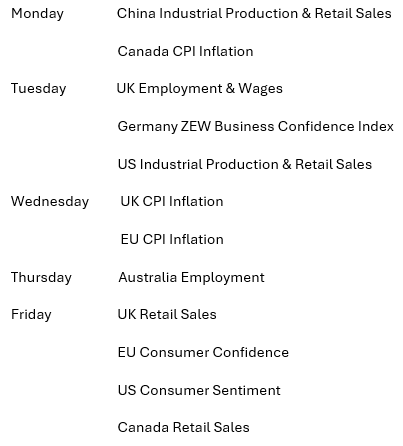
Over the next seven days, there’s plenty of top-tier data from both sides of the Atlantic to keep the markets on their toes.
In the coming week, the key economic data releases and significant events include:
Quote
Haruki Murakami, Japanese novelist, “Spend your money on the things money can buy. Spend your time on the thing’s money can’t buy.”