
12/09/2026 by Tony Redondo
Britain’s problem is not Brexit but the price of everything, above all, energy.
Energy bills are heading up again. The North Sea sits half-licensed while ministers dither over Jackdaw and Rosebank. Andy Burnham is trying to sell an EU “reset” with a price tag running into the billions. And gilt yields are sitting at levels we haven’t seen in nearly two decades. None of these things happened by accident, and none of them happened in isolation.
Start with energy, because it’s the one that actually explains the stagnation better than the referendum ever did. British industry has paid some of the highest electricity prices in the developed world for years, not because of the 2016 referendum vote, but because of two decades of policy that piled subsidy on top of tax on top of regulation, while doing precisely nothing to make gas and oil cheaper to produce here at home. Blaming Brexit for that is politically convenient but analytically lazy. Germany has the same stagnation problem and never left anything.
The North Sea decision ought to be the easiest call in government. Leave a licence unsigned and you get zero tax revenue, zero jobs, and the oil gets pumped somewhere else with a bigger carbon footprint getting it here. Sign it and you get all three, plus a modest dent in the balance of payments. The arguments against, that UK supply is too small to matter to global prices, except when it apparently matters enormously to the climate are nonsensical and don’t survive contact with each other. This isn’t ideology. It’s basic arithmetic, and Fahnbulleh sitting on the decision beyond the 8 October by-election is costing the country money every single month it drags on.
Then there’s the EU reset. I’ll say the obvious thing nobody in Westminster wants to say plainly. There is no version of closer alignment that doesn’t cost money, and the people promising you it’s a free lunch are the same people who told you the 2016 vote would be. Lobby-group costings — and the £17.6bn-a-year figure doing the rounds falls into that category — deserve exactly the same scepticism you’d apply to a sell-side research note with a house position to defend. Treat the headline number as the top end of a wide range, not gospel. But even stripping out the more excitable claims, the direction of travel is clear: automatic rule-taking, ECJ jurisdiction, and ongoing contributions with no vote on how the money’s spent is not a reset but a re-entry through the tradesman’s entrance, and Falconer’s refusal to rule out a future rejoin commitment tells you the government knows it.
Which brings me to gilts. Ten-year yields at a 19-year high aren’t happening because of one bad headline — they’re the market pricing in a government that’s borrowing heavily, facing a possible fiscal reset with the EU, and running an energy policy that keeps feeding into inflation through exactly the channel the Bank hates most: second-round effects. Every time ministers reach for a subsidy instead of fixing the underlying supply problem, they nudge the MPC a little further towards another rate rise. And every rate rise makes the government’s own borrowing more expensive, which is precisely the trap Britain is in right now.
For anyone moving money in or out of the country at the moment, the read-through is straightforward. The Pound is being asked to absorb political risk on three fronts at once, energy, fiscal, and Europe, and none of them are close to being resolved. I wouldn’t bet on calm.
Currency Exchange Rates Update
The Pound finished the week 0.21% up on the Euro and 0.08% up on the US Dollar.
The consensus view among analysts is that on Thursday, the BoE (Bank of England) will keep the Bank Rate unchanged at 3.75% with July’s 6-3 vote split likely to be repeated and be more cautious in tone. The annual QT review is expected to see the APF (Asset Purchase Facility) reduction target lowered from £70bn to £50bn, largely reflecting fewer gilt redemptions rather than a significant reduction in active sales.
Analysts at the independent research house TS Lombard see the Pound underperforming the Euro on the ECB ‘out hawking’ the BoE.
Wealth Club chief investment strategist Susannah Streeter disagrees, and thinks Friday’s better than expected UK GDP data release makes an interest rate rise before Christmas “a touch more likely”
The money markets are now pricing in four quarter-point rate rises by July 2027, which would see the Bank rate rise from 3.75% to 4.75% in less than 12 months.
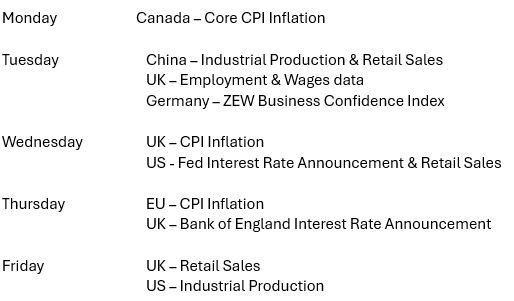
In the coming week, the key economic data releases and significant events include:
What’s in the news?
New research shows just 6% of UK adults think schools have the biggest influence on children’s attitudes to money and 26% of parents admit they lack the confidence to teach their kids basic money skills. The result is entirely predictable: children left without any real financial education.
Britain has never had a coherent financial education curriculum. So, the job falls to parents, most of whom were never taught this stuff either. Expecting hard-pressed families to build financial resilience in their kids, with no tools and no school baseline to work from, just recycles the same anxiety and low capability down the generations. Lower-income households take the biggest hit, as always.
Money habits are set by age seven. Waiting until secondary school is far too late. Primary education needs to start with needs versus wants, then build up through budgeting, tax, interest, credit and scam awareness.
Other countries manage this. Denmark weaves personal finance into early learning. Over half of US states now mandate a high school personal finance course. Japan’s Central Council for Financial Services Information runs a structured, nationwide curriculum from early childhood, grounded in the social context of spending and saving.
Without mandatory primary coverage and proper teacher training to deliver it, Britain will keep failing young people on basic financial readiness, exactly as it has for generations.
UK – – Burnham’s welfare gaffe hands Tories a gift
At PMQs on Wednesday, Andy Burnham told the Commons that “national security can’t come at the expense of social security” when Kemi Badenoch pressed him on the government’s non-existent plan to get defence spending to 3% of GDP. He’s since scrambled to walk it back, insisting national security remains the “first duty” of government. The Tories have already pocketed the line as proof Labour has no intention of getting welfare spending under control.
Meanwhile the economics are getting harder to spin away. Arthur Laffer, adviser to three US presidents and no stranger to a soundbite says Britain is in a “death spiral,” taxing itself into decline while investors head for the exits. His line is blunt, “I have never heard of an economy being taxed into prosperity. Britain is taxing itself into death. Your problem is not too little revenue. Your problem is too little growth, too little prosperity.”
The bond market agrees. The benchmark UK 10-year gilt yields have hit their highest level since August 2007, and Britain’s rise has outpaced every other G7 economy amid mounting doubt over the public finances and the looming Budget. Rupert Harrison at PIMCO, which runs $2 trillion (£1.5 trillion) in assets put it plainly: the UK is “paying a premium because of a perceived loss of economic and fiscal credibility.”
Then there’s Ken Rogoff, former IMF chief economist and now at Harvard, warning the bond rout is a bigger threat to Britain than to any comparable economy and could ultimately force Burnham to the IMF’s door. His assessment: “The UK and the US might be the two most vulnerable countries, and probably the UK more vulnerable. There’s no growth story at the moment in the UK. The debt levels are high, interest rates are high, and growth is not… If your debt is high, the interest rates you’re paying are already high, you’re politically paralysed. Often that’s a recipe for having a debt crisis.”
Against that backdrop, the political class carries on as normal. Birmingham City Council, bankrupt and the most indebted local authority in the country is spending £2.6 million ripping British flags off its streets. And Green Party deputy leader Mothin Ali, whose party campaigns against private landlords, turns out to be sole director of a company that owns two buy-to-let properties in Leeds. Say one thing, do another. Business as usual.
Good news
ONS (Office for National Statistics) data show UK GDP rose 0.4% m/m in July, beating the flat forecast with growth entirely services-driven, riding the World Cup’s hospitality bounce. Services make up 81% of the economy, so one good month there masks a real contraction in production and construction. GDP counts turnover, not margin: costs are rising, borrowing bites and margins are being squeezed outside services.
Separately, the City of London Corporation says UK assets pulled in almost £200bn of new investment in 2025, taking total holdings to £4.1tn, up 5% on 2024. Domestic investment grew, but Britain’s share of global FDI (Foreign Direct Investment) and sovereign wealth flows is slipping.
Over forty retailers including John Lewis, M&S, Pets at Home, and Asda are working with the DWP on 100,000 placements for NEETs (Not in employment, education or training) aged 18-24.
McLaren is reportedly planning a £450m Woking investment, creating up to 1,000 jobs, backed by Abu Dhabi’s CYVN, with an announcement due next week.
Not so good news
The BCC (British Chambers of Commerce) has told Chancellor Healey that tax rises at the 28 October Budget would put the UK on the “road to ruin.” Its message is simple. Stop piling taxes on firms and start cutting the costs they face instead. The BCC wants help getting young people back into work, lower business energy bills, and a roadmap to reduce taxes. Its headline ask: fund employer NICs cuts for under-25s by scrapping the pension triple lock.
Meanwhile the exodus continues. Hedge fund magnate Chris Rokos’s departure for Greece alone leaves a £330m hole in public finances, equivalent to the tax paid by 38,000 average earners. He joins Lakshmi Mittal, Nassef Sawiris and Checkout.com’s Guillaume Pousaz out the door since the non-dom regime was scrapped. Wealth Club’s own client survey found 61% have considered leaving over tax fears, with 16% actively planning it. The average assets of those surveyed is £4.5m. Tax specialist James Quarmby now reckons the non-dom crackdown will cost the Exchequer £4bn, against a budgeted £3bn gain. Someone has to make up that £7bn swing, and it won’t be the people who’ve already left.
The bond market isn’t helping either. The DMO paid 5.82% on £4.25bn of 30-year gilts, the highest yield it’s ever recorded in nearly 30 years of existence with warnings of a £20bn hit to the public finances attached. Debt interest is forecast to sit above £100bn a year well into the 2030s, and average yields on new UK debt have held at 30-year highs for two years running.
On energy, PM Andy Burnham is delaying sign-off on the Jackdaw gas project until after the 8 October by-election on Sir Keir Starmer’s old seat, a contest expected to come down to the Greens’ Zack Polanski against Labour’s Sagal Abdi-Wali, despite warnings of a looming “gas supply emergency” this winter. Jackdaw’s sister project, Rosebank, faces the same Left-wing Labour opposition.
Plans to let English mayors levy uncapped tourist taxes have triggered hospitality-industry warnings of £1.6bn in losses and 30,000 jobs gone.
Convenience stores are cutting investment and turning to automation as costs bite, per the 2026 Local Shop Report.
UK house prices fell 0.4% year-on-year, the first annual decline since November 2023, driven by drops of 1.6% in the Southeast and 1.5% in London, even as Northern Ireland (+6.9%) and Scotland (+3.5%) keep rising.
US firms are cooling on Britain according to the BAB transatlantic confidence index which shows UK-bound US confidence at 6.4, while UK firms’ confidence in the US climbed to 8.1. Overall FDI (Foreign Direct Investment) into the UK fell £14bn last year.
Josh Simmons gave up his Makerfield seat and £92,000 salary to let Burnham back into Parliament. He’s landed on his feet as Burnham’s Head of Policy on £180,000 a year.
USA – The US marked the 25th anniversary of 9/11 on Friday.
Kevin Warsh, the new Fed chief appears to be opening the door to a rate rise next Wednesday. Traders certainly think so: markets are pricing in a 90% probability of a 0.25% rate rise.
US long-term bond yields spiked to three-year highs on Wednesday, after Treasury Secretary Scott Bessent’s bond buybacks failed to impress markets.
Women accounted for 98% of the 162,000 jobs the US added in August, a striking figure that could point to broader shifts in the labour market. The growth came from health and caregiving, but also from local government and education.
August also saw federal government employment fall to 2.67 million, the lowest level since May 1966.
Wholesale prices rose 0.4% in August, as expected. Core PPI (Producer Price Index) was up 0.2%, slightly softer than forecast. On an annual basis, headline PPI rose 5.4%, 0.1% above estimates.
Friday’s CPI inflation data showed a rise of 0.4% in August, putting the 12-month rate in line with estimates at 3.4%. Core CPI, though, accelerated to 0.3% for the month, a touch higher than expected, with annual core inflation at 2.4%.
Credit card debt keeps climbing for many Americans in 2026. According to LendingTree data for the first quarter of 2026, the states carrying the heaviest balances are:
- New Jersey — $9,733
- Connecticut — $9,645
- District of Columbia — $9,511
Unsurprisingly, these are also among the states with the highest incomes and cost of living.
US diesel hit $6 a gallon on Friday for the first time ever, as supply disruption from the wars in Ukraine and Iran pushes transport costs up across the economy. Truckers and farmers are now paying about 63% more to fill up their rigs and tractors than this time last year, according to AAA. The national average sits at roughly $6.06 a gallon, higher still in California, the country’s biggest agriculture state, at $7.98.
President Trump has promised every American $5,000 if Republicans hold Congress in November’s midterms, comments critics say expose his party’s weakness ahead of the vote. Trump’s approval rating averages just 38%, and that unpopularity is weighing heavily on Republican chances, pushing some candidates to put distance between themselves and the man they once courted. Beyond the backlash over the Middle East war, voters have soured on the administration’s handling of the economy, a problem that could deepen if the “Trump dividend” goes ahead: 10-year borrowing costs hit a near three-year high on Wednesday.
The EU
ECB holds the line, but the real story is what’s coming
The ECB delivered exactly what the market priced, a 0.25% rate rise to 2.5% on Thursday with Eurozone inflation at 3.3% and energy inflation spiking to 14.3%. ECB President Christine Lagarde’s own guidance is that core inflation will finish at 2.5% in 2026, 2.6% in 2027, 2.3% in 2028 so the ECB doesn’t expect this to resolve quickly. Bond markets have already worked this out: European yields are at multi-decade highs as investors price in a longer, harder fight against inflation than anyone wanted to admit just six months ago.
Europe still can’t decide if it wants to fight China or just complain about it
Brussels rolled out “Made in Europe” guidelines this week to protect manufacturers from Chinese competition. No binding quotas, though which tells you everything about how seriously this will actually be enforced. Nine Chinese firms selling robotic lawnmowers are now targeting the EU. China doesn’t have lawns. That’s not industrial strategy, that’s dumping excess capacity on a market too divided to defend itself. France and Germany can’t even agree a quota system between themselves. Brookings, one of the oldest and most influential policy research organizations in the world thinks the EU won’t muster the unity to counter Beijing, and that’s been true for twenty years running.
Germany’s political centre is collapsing in real time
The AfD took 43.8% of the vote in Saxony-Anhalt on Sunday. Merz’s CDU limped in second on 17.2%. That’s not a protest vote, that’s a realignment. The AfD’s tally has more than doubled in five years to 39 seats out of the 83-seat parliament, close enough that the “firewall” against working with them will finally be tested for real. Chancellor Merz says he’s “deeply shocked.” He shouldn’t be. Voters have been telling mainstream parties what they think for years. This is just the first time the numbers were too big to explain away. Federal elections aren’t until 2029, but the pressure on Berlin to address why people are voting this way has started.
Greece has gone from a bail-out to welcoming billionaires
Hedge Funds billionaire Chris Rokos paid himself £477 million last year and handed roughly £330 million of it to Britain’s tax authorities. He’s now moving his tax residency to Greece, which offers wealthy newcomers a flat €100,000 annual tax on foreign income for up to 15 years, plus favourable inheritance tax treatment. Athens has gone further with a 5% tax on bonuses and carried interest for private equity and hedge fund executives who relocate while Britain sadly moves in precisely the opposite direction. Rokos gave £190 million to Cambridge on top of everything else yet the UK government insist on treating people like Rokos as an ATM that can’t walk away rather than an asset worth keeping. Greece gets the office, the jobs, the spending, the investment.
Spain’s Ceuta crisis is turning political fast
Pedro Sánchez and Vox leader Santiago Abascal traded blows in parliament this week, with Abascal calling the PM a “traitor” over his handling of Ceuta and accusing him of being too accommodating to Morocco. Tens of thousands of migrants have arrived at the exclave, and the temperature is rising. Alberto Núñez Feijóo, leader of the opposition Partido Popular addressed roughly 50,000 people in Madrid, accusing the government of allowing a Spanish city to be “invaded” with its own knowledge. Protests are spreading in Ceuta itself. Whatever the merits of the government’s actual handling of it, Sánchez now has a genuine street-level legitimacy problem.
Australia – RBA turns hawkish as inflation refuses to budge
Official CPI (inflation) is sitting at 3.5%, with underlying inflation stuck at 3.6% and the markets have reacted the only way they know how: sharply hawkish. NAB and the rest of the major lenders are now pricing in a high probability of a 0.25% rate rise to 4.6% when the RBA meets on 29 September.
Commonwealth Bank and ABS data both point to a broader slowdown taking hold. Annual GDP growth has moderated to somewhere between 1.5% and 2.1%. Private demand is still doing the heavy lifting, propped up by capex in renewables and data centre infrastructure, but household consumption is softening under the twin weight of cost-of-living pressure and elevated borrowing costs.
Unemployment has edged up to 4.5%, the clearest sign yet that wage growth is starting to level off.
Elsewhere, Australia has reportedly struck a new treaty with the Solomon Islands, the latest in a run of deals Canberra is racing to lock in as a hedge against China’s growing regional footprint. The agreement includes $700 million from Australia to the Pacific nation and follows on from a recent security pact with the US. Canberra has also signed mutual defence agreements with Fiji and Papua New Guinea, is negotiating a similar arrangement with Tonga, and has deals with Tuvalu and Vanuatu that bar them from security cooperation with Beijing. As The Economist put it: Pacific leaders aren’t choosing between America and China but choosing to deepen ties with Australia.
Canada – Trade war bites, but the money keeps arriving
Trade friction with the US and a domestic investment push dominated the Canadian news agenda this week.
The US administration announced import bans and restrictions hitting Canadian dairy, alcohol, motorcycles and aerospace with Bombardier singled out by name. Canada hit back with $27.6 billion of retaliatory tariffs on US goods, which took effect early in the week. The chances of averting a full tit-for-tat trade war look slim.
Prime Minister Mark Carney talked down further escalation while quietly lining up support with loans and benefits for the small businesses and industries caught in the crossfire.
There’s a small silver lining. A cohort of Canadian manufacturers are cashing in on the patriotism with anything stamped “Made in Canada” flying off shelves as Canadians vote with their wallets against Trump.
Meanwhile, Ottawa is making its pitch to global capital. A new prospectus lists 167 major infrastructure, energy, pipeline, railway and AI projects, timed ahead of an investment summit, and the banks are already responding. BMO has committed $70 billion to domestic industry, and CIBC $2 billion to defence-related SMEs.
The labour market, though, is a worry. Statistics Canada’s August data showed 42,000 jobs lost. The unemployment rate only held at 6.4% because the labour force shrank to match. That’s not resilience, that’s people giving up on looking.
Others
China: growing exports, weak imports, still no rebalancing
China’s trade growth picked up pace in August, but imports missed forecasts, handing Beijing another reason to face the rebalancing question head-on ahead of its high-stakes summit with Washington this month. Semiconductor exports up 130% year-on-year did the heavy lifting. Everything else? Same old story — ING’s China chief economist calls it a “divergence” between what China sells abroad and what its own consumers are buying. That gap isn’t closing.
Inflation, meanwhile, picked up for the first time in months with energy and food prices doing the damage, in an economy that only recently was staring down deflation. Add youth unemployment pushing 18% and a Middle East conflict threatening to squeeze the world’s biggest oil importer further, and Beijing’s households are caught in a pincer. Unsurprisingly, criticism on Chinese social media is mounting, despite the obvious risks of speaking out.
The lack of free expression is back in the spotlight. Two weeks after a deadly glacial flood at the China-Nepal border, we still know almost nothing about the Tibetan communities affected with video evidence scrubbed, dissenting voices threatened with fines or jail. The New York Times has a name for it, China’s “disaster playbook.”
South Africa: growth reverses, refining ambitions grow
South Africa’s GDP contracted 0.2% in the second quarter with the Iran war putting a full stop to an 18-month growth spurt in the continent’s biggest economy. Weaker demand plus higher fuel costs from the Strait of Hormuz blockade hit mining, trade and manufacturing hard.
The South African Reserve Bank raised its interest rate in May to head off war-driven inflation and meets again on 23 September. Capital Economics reckons the tightening cycle is done.
On energy, South Africa’s just announced plans to at least triple its refining capacity, joining a wider African push for energy independence after the Middle East war exposed how exposed the continent really is with roughly 70% of refined fuel imported. Africa’s richest man is building a mega-refinery in Kenya, modelled on his existing giant in Nigeria. Solar’s stepping up too. Ember projects a 45% jump in Africa’s solar adoption this year.
Oil, fuel, copper, all pointing the same way
WTI broke above $104 a barrel and Brent topped $109 on Thursday, their highest since 19 May, with markets bracing for a drawn-out Iran war. Retail petrol hit a Labor Day record on Monday in the US.
Copper’s not sitting this one out either. An all-time high this week, up more than 68% since Trump’s Liberation Day speech back in April 2025.
Stranger than fiction
A material found in crab and shrimp shells, usually binned by the seafood trade has been turned into a gel and used as the working fluid inside a zinc battery. The zinc anode ran for more than 1,000 cycles at 99.7 percent Coulombic efficiency, outlasting conventional alternatives. That points to a genuinely cheaper, greener route to energy storage and not just a lab curiosity.
So how does a crab shell end up inside a battery?
The link runs through chitin, the tough material that makes up the shells of crabs, shrimp and lobster. Treat it with the right chemistry and you get chitosan, a softer, workable version. The seafood industry produces mountains of shell waste every year, which is exactly the appeal. Researchers turned that chitosan into a gel and used it as the electrolyte, the medium that lets charge flow between the two ends of the battery.
Bury the chitosan gel in soil and microbes break it down completely in about five months. What’s left is the zinc metal, which can be recovered and recycled. Roughly two-thirds of the battery breaks down this way.
Quote
Benjamin Franklin, “Well done is better than well said”