
05/09/2026 by Tony Redondo
The OECD (Organisation for Economic Co-operation and Development) reckons governments and corporations worldwide will borrow $21 trillion from global bond markets in 2026. That’s $21,000,000,000,000.00, $5 trillion more than 2024, and double what was borrowed just ten years ago.
For perspective: a million seconds is roughly a week and a half; a billion seconds spans over 31 years; and a trillion seconds reaches back 31,688 years, predating recorded civilisation.
What worries me even more than the sheer scale is the direction of travel. The OECD forecasts that some 50% of that $21 trillion will go purely to refinancing existing debt. Governments almost never repay the principal. When a bond matures, they simply issue another to redeem the first, then borrow even more to cover the current deficit and the interest run up by previous administrations. The whole system holds together only for as long as investors are willing to keep rolling the debt forward.
To be clear, $21 trillion is this year’s annual borrowing alone, not total outstanding debt. Sovereign and corporate bond markets combined already sit at roughly $115 trillion.
The OECD notes that 30-year yields have climbed sharply across most countries since 2022, pushing governments and companies toward shorter-dated debt. This lowers the amount of interest payable in the short run but forces borrowers back to market far more frequently. Issue a 30-year gilt and you’re insulated from near-term rate moves. Roll short-dated debt instead and you’re back at the mercy of whatever the market demands, again and again. A 1% rise looks trivial on paper but applied across trillions in recurring issuance, it swallows hundreds of billions that have to come from somewhere: higher taxes, thinner services, inflation, or yet more borrowing.
Meanwhile the BoE (Bank of England) is running down its own gilt holdings, QT (quantitative tightening), the hangover from years of QE (Quantitative Easing). As the BoE steps back, hedge funds, pension funds and foreign investors are left to absorb the growing supply. These buyers are far more sensitive to inflation and political risk, and they’ll price that in or walk.
The OECD’s advice to member governments is to secure “long-term sustainability.” Politicians, watching the polls, thinking in electoral cycles won’t touch spending until the bond market forces their hand. Every line of expenditure has a constituency; every reform threatens someone’s seat. So instead, they’ll raise taxes, lean on the markets, adjust the accounting rules, and blame speculators, anything but take responsibility.
Which brings us to this week. UK borrowing costs have risen at one of the fastest paces globally, hitting an 18-year high amid a broader bond rout, piling pressure on Chancellor John Healey ahead of his first budget, the government’s third, due on 28 October. The 10-year gilt yield hit 5.2944% on Wednesday, its steepest rise since May. The 20-year cost of borrowing is now at its highest since 1998, a clear signal of market stress. Under normal conditions, short-dated yields run below long-dated ones.
Andy Burnham’s £100bn Tax Plan: Inside the Prosperity 2030 Reforms – Cosmos Currency Exchange
Lord O’Neill, the former Goldman Sachs economist who turned down a role in Andy Burnham’s government said the tone of the Prime Minister’s debut speech on Tuesday was the last thing investors wanted to hear.
Higher borrowing costs eat directly into what Burnham and Healey can spend without raising taxes or breaking the fiscal rules left by predecessor Rachel Reeves. Ruth Gregory at Capital Economics puts the damage at £9bn wiped off the Budget headroom, down from nearly £24bn at the spring statement to around £15bn now. Her view is that Healey may be walking straight into the same headroom trap Reeves faced, needing £9bn–£14bn in cuts or tax rises just to restore credibility.
David Aikman at the respected NIESR (National Institute of Economic and Social Research) made the underlying point plainly. Years of heavy borrowing have left Britain exposed to exactly this kind of shock in global markets.
Currency Exchange Rates Update
The Pound ended the week 0.39% down against the Euro, dropping 1.03% since 30 August and just above a two-month low.
Against the US Dollar, the Pound ended the week 0.42% up on the greenback.
Against the Australian Dollar, the Pound fell more sharply, closing the week 0.71% down to levels not seen since the beginning of June.
‘Buy holiday cash now’ and ‘save €230’ ahead of ‘change after this week’ – The Mirror
The Bank of England is now expected to raise UK interest rates three times over the next two years after two-year gilt yields, which gauges short term interest rate expectations, jumped to 4.5334%, their highest levels since November 2023, pushing up borrowing costs and putting the UK’s economic stability under threat.
Analysts have said that the UK is suffering from higher gilt yields due to the government’s profligate spending and vulnerability to inflation shocks. On Thursday, Brent crude oil prices rose above $97 a barrel, their highest level since July while European gas prices hit a three-year high, deepening fears that the UK will suffer from higher price rises than previously expected.
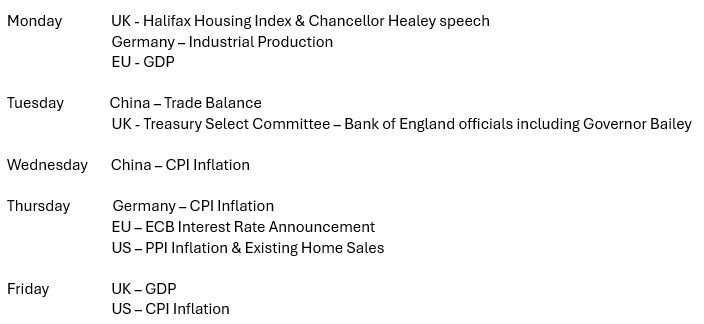
In the coming week, the key economic data releases and significant events include:
What’s in the news?
UK
Eleven weeks ago, with Sir Keir Starmer still PM, John Healey resigned as Defence Secretary because the Treasury would not fund defence at the level, he said the country needed. Healey is now Chancellor under PM Andy Burnham and confirmed his own first Budget won’t set a date for reaching that 3% of GDP on defence either. That call has been pushed into next year’s Spending Review. What has changed, other than the chair he is sitting in?
Six weeks ago, Starmer said he’d stay in Parliament serving his Holborn and St Pancras seat that he has held for 11-years. This week, Starmer performed his last U-turn by announcing his resignation as an MP, roughly two hours before Andy Burnham’s maiden speech as Prime Minister on Tuesday, leading one commentator to say, “Oh Keir, you big, important muffin of global grandiosity”. Made me laugh.
Remember Starmer’s digs at Rishi Sunak heading off to California after losing the 2024 general election? The suggestion that Sunak would abandon British politics for some cushy life in California. Except Sunak stayed put. Having lost the 2024 general election, Sunak left Downing Street and stayed in Parliament. He’s still the MP for Richmond and Northallerton. His wife voluntarily stopped claiming non-dom status and now pays UK tax on her worldwide income. Substantial sums, given her wealth.
Where might Starmer end up? The EU, UN or given his passion for football, as head of FIFA or at the WEF in Davos.
Labour grandee and former home secretary Alan Johnson thinks Andy Burnham needs to call an early general election before next summer to prove his policies are popular. Speaking to Times Radio, Mr Johnson, who was a Cabinet minister under Tony Blair and alongside Mr Burnham under Gordon Brown, said, ‘He (Burnham) can’t really, I don’t think, see out the whole Starmer term… until 2029. He’s got to think about going to the country before that and getting his own mandate.’
Conservative leader Kemi Badenoch has been handed a big poll boost with the latest survey by More in Commons putting the Conservatives ahead of Reform UK for the first time in 18 months. Labour is in the lead on 26%, down one point from the week before, as the party enjoys a bounce under Andy Burnham. The Tories are up one point in second place on 23%, while Reform are down one point on 22%. The Lib Dems are on 11%, Zack Polanski’s Green Party is on 9%, while Rupert Lowe’s Restore Britain takes 4%. More in Common polled 3,250 people between 28 and 31 August.
Badenoch promoted Andrew Griffith to the role of Tory Shadow Chancellor, replacing Mel Stride. Griffith has more private sector experience than the entire Labour Cabinet.
Good news
The UK now has full access to the CPTPP, (Comprehensive and Progressive Agreement for Trans-Pacific Partnership), following the final ratification from Canada. This gives UK businesses complete access to the CPTPP, whose entire market is worth £10trn. CPTPP is a trading bloc of 12 countries, including the UK, Canada, Australia, Chile, Peru and Japan, accounting for over 7% of global population and 15% of global GDP. Expansion talks are ongoing with countries like the Philippines and the United Arab Emirates.
The UK formally joined the CPTPP on 15 December 2024 following years of negotiations, and each member needed to ratify the UK’s entry in order for traders to access the bloc’s benefits in each member country. BIST, the Department for Business, Innovation, Science and Trade says that the agreement is due to provide around £2bn to the UK economy “in the long run” and highlights the 99% tariff reduction that comes with full membership of the CPTPP.
London Underground, the oldest metro system in the world, will finally catch up with Berlin and Paris in having mobile signal across its stations and lines. A long term project of threading fibre-optic cables and hanging antennas in packed tunnels and stations is due to finish by the end of this year.
Not so good news
The boss of John Lewis has warned that the UK economy is locked in a “permacrisis” as he urged the government not to raise business rates on large retailers. Peter Ruis, the outgoing managing director of the retail giant, said that British businesses are facing a “permacrisis externally [which] isn’t going to go away”. Ruis appealed to the government to reform the business rates system rather than raise the burden facing large retailers.
A group of retailers including Tesco, Sainsbury’s and Marks & Spencer warned earlier this week that the government could raise the highest business rates multiplier, which applies for stores with a value of more than £500,000.
Asda Boss Allan Leighton said that Labour’s economic policies are damaging growth by piling costs on businesses and households and bringing the economy to a “tipping point” before the Budget. Leighton said, “The economic model that we’ve been pursuing, or the Government is pursuing, has inhibited growth because it’s put heavy taxation and heavy costs on consumers. When that happens, consumers spend less, their confidence goes down, and businesses invest less. You don’t have to go to Harvard to work that out.” He added that the next Budget, due on 28 October would determine whether the Government could avoid further damage to the economy. “We can either inhibit growth, which has been the strategy so far, not inhibit growth, which in itself would be something, or thirdly, do something that really helps growth. That’s why I think we’re at a tipping point.”
According to the BRC (British Retail Consortium), UK shop price inflation has reached a two-year high, accelerating to 1.5% in August, its highest level in two years. Food inflation rose to 2.8% with ambient food prices climbing 2.5% as higher energy, commodity and input costs increasingly filtered through supply chains.
The number of small landlords in the UK has dropped for the first time in five years due to tax increases and concerns about new rights for tenants. Around 30,000 exited the market in the year to April 2025 after Rachel Reeves raised stamp duty on additional residential properties from 3% to 5%. Paul Shamplina, founder of campaign group Landlord Action, said that since the Renters’ Rights Act came into force in May this year, even more landlords have been selling up, with this acceleration expected to be seen in future statistics.
The S&P Global UK manufacturing PMI (Purchasing Managers’ Index) fell to 51.7 in August, a five-month low as smaller producers came under renewed pressure. Matt Swannell, chief economic adviser to the Item Club, warned that manufacturers could face a “difficult” period as the economic effects of the Iran war feed through into business costs and household finances.
Employment in the UK’s dominant services sector, responsible for around 80% of the UK economy dropped for the 23rd consecutive month in August as businesses maintained hiring freezes and trimmed headcounts following cost pressures. S&P’s latest PMI for the services industry revealed the sector has continued its longest continuous stretch of workforce reductions since records began in 1996.
According to the BCC (British Chambers of Commerce) who launched a business cost calculator this week, a typical-mid-sized firm in the UK is forecast to be paying roughly £827,000 more a year than they were in 2016 as a direct consequence of domestic policy decisions from the government.
USA
The global bond selloff extended throughout the week amid renewed tensions in the Middle East with the US and Iran resuming tit-for-tat strikes following roughly a month of relative calm, sending oil prices higher and prompting investors to reprice the expected path of policy rates in a more hawkish direction. WTI crude prices touched nearly $93 a barrel this week, their highest level since June.
The shorter-dated 2-year Treasury note yield, which tends to react in line with short-term Federal Reserve interest rate decisions, rose to 4.379%, its highest level since January 2025. The key 10-year Treasury note, the main benchmark for mortgages, auto loans and credit card debt hit 4.816% on Wednesday, its highest level since October 2023.
On the data front, the August ISM PMIs were relatively weak, despite a still-solid underlying trend. Manufacturing activity and new orders both came in below expectations and July levels.
On Friday, the key NFP (Non-Farm Payroll) employment data smashed through the consensus analysts forecast of 53,000 new jobs created with 162,000 jobs added in August, indicating that the labour market retains momentum ahead of a crucial Federal Reserve vote on interest rates due on 16 September. These figures means August’s total was the strongest monthly gain since March. The unemployment rate remained at 4.1%. The report points to a steady US labour market and likely turns the Fed’s focus to next week’s inflation numbers as the final determinant heading into the interest rate decision.
One of the stock market’s most reliable long-term indicators is flashing red with the S&P 500 now trading at 41 times earnings, surpassing the valuations that preceded the 1929 Wall Street crash.
Optimists say AI justifies the lofty valuations but are at a rating more than double that of their British and European counterparts, and the highest since the peak of the dotcom bubble.
US President Donald Trump imposed up to 100% tariffs on drones, targeting Chinese-made models in particular over national security concerns. China’s DJI alone accounts for more than 70% of the global market, and US law enforcement uses its devices to track wildfires and find missing persons. But drones are also increasingly vital for military purposes with US regulators effectively barring the sale of new models over national security concerns.
Citibank has been hit with a fine of nearly £5m after the UK regulators found it violated the UK’s sanctions regime on Russia. The Wall Street giant’s London branch was found to have processed £19.7m in illicit transactions spanning 970 payments. The OFSI (Office of Financial Sanctions Implementation) ruled that, in one instance, Citi failed to freeze as many as 24 commercial bank accounts belonging to 11 companies controlled by a single designated Russian individual. Of the £5.9m in funds passed through by that client, around £4.3m was processed in the first 24 hours of the individual being placed on the sanction’s watchlist. OFSI said Russia’s invasion of Ukraine, which prompted strict sanctions from the UK, had “placed significant strain on the bank’s alert handling and investigation processes.” To handle the backlog, the bank was found to have temporarily altered its compliance guidance in May 2022 to stop restricting accounts unless it had evidence of over 50%ownership by an individual on the sanctions list. In May, Deutsche Bank was handed a £160,000 fine after it was found to have authorised two payments linked to a sanctioned Russian firm between June and July 2022. A subsidiary of Lloyds Banking Group was also fined at the beginning of the year for sanctions breaches after opening a bank account for an ally of Vladimir Putin. The Bank of Scotland was also handed a £160,000 fine for processing 24 payments, totalling £77,383, from a personal current account held by an individual under Russian sanctions.
The EU
Inflation in the Eurozone has edged higher again, rising to 3.3% in August.
The ECB (European Central Bank) will announce its interest rate decision on Thursday, a week ahead of the Federal Reserve, Bank of England and Bank of Japan. A 0.25% rate increase is widely expected. The greater focus will be on guidance from President Lagarde at the post-meeting press conference and the ECB’s updated staff economic projections. The balance of risks remains tilted towards a further rate increase in December, with markets currently assigning a probability of around 90%.
Iceland has rejected commencing accession talks to join the EU in Sunday’s referendum by a margin of 52.8% voting No against 47.2% for Yes. Iceland applied to join the EU in the wake of the 2009 financial crisis, but in 2013 the country put membership talks on hold after a Eurosceptic government came to power. Iceland must hold a general election by November 2028.
Germany’s economy has shown surprising signs of strength lately. Consumer, investor and business confidence has rebounded, factories are taking more orders, and growth is the fastest since 2022.
However, Germany is facing a gas shortage that could drive up winter energy bills for already battered households and industry. That risks sending the barely reheated economy back into the deep freeze. The amount of gas in the storage facilities is the lowest for this time of year since records began in 2009. The tanks are only 51% full. By the start of November, the aim was to hit 70%, but most forecasters reckon there’s now little chance of getting anywhere past 60% by then.
Volkswagen said it will slash 50,000 additional jobs, bringing the total to 100,000 by the end of the decade, the most in automotive history as VW faces cutthroat competition from Chinese carmakers.
The AfD, which opposes immigration has a double-digit polling lead in Saxony-Anhalt, a former East German region where many people have felt economically and socially left behind since reunification in 1989. That poses a big dilemma for German Chancellor Friedrich Merz’s CDU party, which is polling second in Saxony-Anhalt. The AfD has surged in national popularity and is now the second-largest party in the Bundestag, is set to make gains in two other upcoming elections in the former East this month as well.
Italian Prime Minister Giorgia Meloni is now the longest-serving leader since 1943.
In Spain, tens of thousands of people took to the streets on Wednesday in protest against Prime Minister Pedro Sánchez’s welcoming immigration policy and his handling of the immigration crisis in the North African Spanish enclave of Ceuta. In July, more than 70,000 people crossed into Ceuta from Morocco in the space of 48 hours. At least 100 people died in the rush, and around 5,000 migrants remain stranded in makeshift camps in Ceuta. At the protests, calls for his resignation were accompanied by signs reading “Sánchez to prison” and “Invaders — go home!” Sánchez has deflected criticism for the crisis toward Russia and Israel, which he has suggested, without clear evidence, spread misinformation about Spain’s migration policy in order to encourage the rush. Frustrations over the crisis now put Sánchez in a tough spot as he faces re-election in 2027.
Australia
Australia posts second-quarter growth of 2.1%, beating expectations. On a quarter-on-quarter basis, GDP rose 0.4%, also marginally surpassing expectations of 0.3%. The Australian Bureau of Statistics said in its statement that households continued to behave cautiously, with spending remaining subdued and rising just 0.4%. Households reduced fuel consumption due to elevated prices owed to the Middle East conflict and cut domestic and international travel.
Stronger-than-expected GDP growth should allow the RBA (Reserve Bank of Australia) room to go ahead with further policy tightening as it seeks to curb inflation. Australia’s July inflation reading surpassed expectations, coming in at 3.5% compared to the 3.3% forecast. The RBA forecast that inflation would decline only gradually, returning to around the midpoint of its 2%-3% target range by late 2027.
Australia’s services sector expanded for a third month straight in August, although growth eased slightly. The S&P Global services PMI slipped to 53.2 while the composite PMI edged down to 52.7 as manufacturing output weakened. New business in the services sector increased for a second consecutive month, helping lift business confidence to its highest level in six months despite softer overseas demand. Transport and storage recorded the strongest gains, while information and communication activity contracted. Businesses continued to face higher fuel and labour costs, but the pace of price increases charged to customers slowed from July. However, consumer confidence fell to 74.9, largely driven by deteriorating expectations for future economic conditions and growing anxiety over sticky inflation and potential RBA interest rate rises.
Canada
On Wednesday, the BoC (Bank of Canada) kept its benchmark policy rate steady at 2.25% for the seventh consecutive meeting.
Second-quarter GDP rebounded to an annualized 3.3%, elevated global energy prices and risks from ongoing trade tensions kept central bank officials cautious about shifting stance.
Fresh data released by Statistics Canada showed the economy shed 42,000 jobs in August, snapping a four-month growth streak and missing consensus forecasts for modest gains. The job cuts were concentrated in the public sector, while the national unemployment rate held flat at 6.4%. Average hourly wage growth decelerated sharply to an annualized 2% in August, down from 2.8% in July, easing upward pressure on domestic service inflation.
Economic uncertainty persists as new US tariffs on select Canadian exports took effect late in August, with Ottawa preparing dollar-for-dollar counter-tariffs. Meanwhile, Scotiabank highlighted that Canadian exporters continue to diversify trade toward European and non-US markets.
Prime Minister Mark Carney’s Liberal government gained political momentum following a sweep of three federal by-elections, including reclaiming a long-held Conservative seat. The victories secured a functional majority in the House of Commons for the Liberal government.
The federal government rolled out an expanded $7.5 billion relief framework to cushion impacted industries and workers from retaliatory trade measures and recently imposed cross-border duties.
Others
China’s official manufacturing PMI rose to 49.8 in August, beating expectations of 49.5 and improving from July’s result. While activity remained below the growth threshold for a second month, demand showed signs of recovery, with both new orders and export orders returning to growth. Elsewhere, the non-manufacturing PMI held steady at 49, missing forecasts of 49.4 and highlighting subdued domestic demand. The composite PMI output index inched up to 49.5.
Solar surpassed coal as China’s top source of power for the first time ever, underscoring the country’s remarkable rollout of green energy as it looks to contain the impact of the Iran war. Solar accounted for almost a third of total installed capacity at the end of July, up from virtually nothing just a decade ago. The world’s largest oil importer has ploughed into renewables at an unprecedented scale, expanding overall power generation and boosting energy-intensive industries like AI.
China remains about 15 years behind the West in developing cutting-edge chipmaking technologies, according to a key supplier of the semiconductor industry. The CEO of Zeiss, a German manufacturer of optical systems, said Beijing’s capabilities still trailed the world’s leading producer of top lithography systems, ASML, but warned that China’s progress was hard to quantify. Chinese firms have made significant strides in catching up to ASML, whose machines cannot be sold to China including recently starting production of deep ultraviolet machines, a step below the world’s most advanced.
Gold’s second strongest monthly price rise of the past decade saw private investor demand jump in August, outrunning investor selling by the widest margin since June 2025. With long-term bond yields hitting new multi-decade highs, this strong demand for gold signals deep worries over the size of government debt and the threat of currency debasement.
Goldman Sachs has more than doubled its diesel margin forecast, the price difference between diesel and Brent crude, as global exports plummet. The Wall Street giant now expects diesel to cost $63 more than a barrel of Brent crude in the US and $49 more in Europe by the end of 2027. This is up from respective margins of $27 and $19 previously forecast in February, before the war in Iran began.
Stranger than fiction
A team of researchers in Japan has created “cyborg” bugs, fitting cockroaches with electrodes and sensors and using AI to control their movement and track their behaviour. The goal is to determine whether an insect’s physiological signals like its heartbeat, neural activity, and body motion can accurately detect hazardous environments in disaster areas, using the bugs as scouts to keep humans out of harm’s way during disaster response. In March 2025, scientists in Myanmar deployed cyborg critters to search rubble in the aftermath of an earthquake, navigating narrow spaces that humans otherwise couldn’t reach.
Self-flying crop-spraying planes are in commercial use in Brazil, highlighting that autonomous vehicles are an increasingly mature technology away from the high-profile business of passenger transport. Robo-planes can fly lower than human-piloted ones, improving their accuracy and thus reducing spray volume.
Nearly two miles underground in South Africa, scientists have found oxygen that has never seen sunlight. In March 2026, researchers descended into the Moab Khotsong gold-and-uranium mine near Johannesburg, tapping brine that geochemical dating shows has been sealed off from the surface for at least 1.2 billion years. Their reading, 0.09 micromoles of oxygen per litre, echoes a 2023 find by the same team in ancient Alberta groundwater. If radioactivity or biology can produce oxygen far from sunlight, then the deep biosphere, already estimated to hold as much as a third of Earth’s biomass, may sustain richer, more complex life than previously assumed. The implications reach beyond Earth. If oxygen can be produced without sunlight, then finding oxygen on another world may not necessarily mean that photosynthesis is happening, and similar chemistry could potentially sustain organisms underground elsewhere.
Quote
Ludwig Mies van der Rohe, German American architect widely regarded as one of the pioneer figures of Modernist architecture, alongside Le Corbusier, Walter Gropius, and Frank Lloyd Wright, “Less is more”.